analysis-0
This note is my bird’s eye view of analysis, espeically developing key ideas in metric spaces and continuity to make our life easier later. Analysis is about problems, counter-examples, and crafting of clever inequality among many other things (not that I would know :)) and we will do plenty of that to come
Analysis-0 - Metric Spaces
In order to do analysis, one needs a notion of distance, and one of the biggest traps is to blindly borrow intuition from or , so we will borrow with our eyes open.
0 - Metric Spaces and Open Balls
a set and a map is called a metric space if:
- for any
- for any
- for any (triangle inequality)
We will work with two objects very often, one is open balls, and the other is punctured open balls:
let be a metric space, for any and any , the set is called an open ball (or open neighbourhood) of with radius .
The set we will call a punctured open ball. Notice that an open ball is always nonempty, (it has its centre at least) whereas the punctured open ball may be empty.
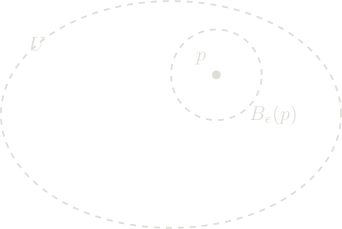
Indeed, if we have a “set without its boundary” intuitively, we know that any point inside, will have some (perhaps really small) open ball around it, completely contained inside that set.
Let , we say is an interior point if there exists some for which .
We say is open if every is an interior point of .
if is a metric space, we see (vacuously) that is open, and is open too.
Extremal Examples
Now, in analysis, we want to hunt for extremal examples. Is there a metric space where all subsets are open? consider with the usual metric . Choose , now let and , notice that .
Is there a metric space where the only open sets are the trivial ones? suppose had at least two points , and let . then is nonempty since it contains , and it is not all of since it does not contain . thus has a nontrivial open set.
therefore, the metric topology on is trivial if and only if .
1 - Limit Points and Closed Sets
The next object of concern is limit points. let be a metric space and . we say is a limit point, if for any , . That is, any punctured ball around has elements in .
It is quite evident that if is a limit point of any ball around has an infinite number of elements in .
For the sake of contradiction, suppose for some , has only a finite number of elements: . set .
Now notice that , but by the choice of , none of is in . thus, , which contradicts the fact that is a limit point of .
we say a set is closed, if it contains all its limit points.
Closed Sets and Open Complements
Now, we shall prove here, as a theorem, what is taken as a definition in topology.
let be a metric space and , then is closed if and only if is open.
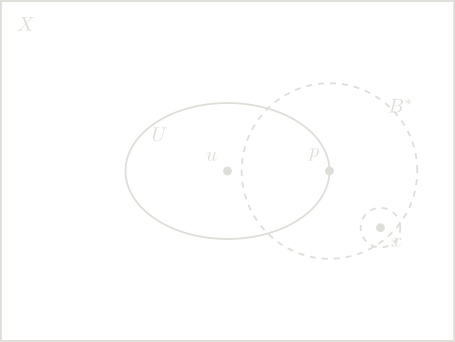
suppose is closed, and let . since contains all its limit points, is not a limit point of . thus, for some , . since , we also have , ie . that is is interior in . thus is open.
The other direction is very straightforward. Suppose is open, and is a limit point of , further suppose , thus is interior to , contradicting that is a limit point of .
2 - The Metric Topology and Continuous Maps
The next claim we will make is that open balls, are the basis which generate the metric topology of a metric space.
What do we require of basis? we need them to be open and cover the space, we need for any point in the intersection of two basis another basis contained in that intersection containing the point. Such things are satisfied by open balls.
Next we will show that any open set is a union of open balls. This is true because in the metric space definition, every point inside an open set is interior, thus has an open ball completely contained in the open set. Thus we can take the union of all such balls.
Open Sets Form a Topology
Next we will show that open sets in the metric sense form a topology: let be a metric space: of course are open.
now, suppose , is a collection of open sets. let , of course, for some , , ie some . Therefore, obviously, , thus is interior in the union of that collection.
now let , be a finite collection of open sets. let , of course then, there exists , such that .
now, let , then for any , .
ie, .
Continuous Maps Between Metric Spaces
Now, if is a map between metric spaces, we have two definitions of continuity, and they better be equivalent:
- is continuous if pre-images of open sets are open, (in the metric topology).
- for each and each , there exists such that implies .
suppose is continuous as given by the first definition.
let , consider any . Indeed, is open in , ie is interior to it. that is, there exists some such that , ie .
Now suppose is continuous as given by the second definition. let be open in . let , now we know that for some , . for that , there is some such that . of course then , thus is open.
Now, it is quite clear, using complements, that in topological spaces (and thus metric spaces) arbitrary intersections and finite unions of closed sets are closed.
3 - Dense, Perfect, and Compact Sets
Now some more definitions:
A subset of a metric space is said to be dense, if for each , either or is a limit point of , moreover if is a metric space such that any is a limit point of , then the space is said to be dense in itself.
Now, if is not a limit point of , then it is called an isolated point of .
Finally is perfect if it is closed and every is a limit point of . ie is perfect if it is closed and has no isolated points.
As with compactness in topological spaces, a subset is compact, if every open cover of has a finite subcover.
note: Most of the properties on a subset of a space, (topological or metric) can be pulled directly down into the subspace induced by that subset, either by taking intersection of open sets, or by inheriting the metric. For example, a space is compact if every open cover has a finite subcover, is a compact subset if and only if as a subspace, it is a compact space.
We say that the empty set is bounded. A nonempty subset of a metric space is bounded if there exists and some such that for any , .
Compact Sets Are Closed and Bounded
Suppose is a metric space and is a compact subset of , then is closed and bounded:
first we will show that bounded. this is immediate if is empty, so suppose it is nonempty and take some . now build a sequence of balls , , . since the distance between any two points is finite, this sequence of balls covers . Of course, it has a finite subcover, but every ball is contained in the next one in this sequence, thus there exists some such that .
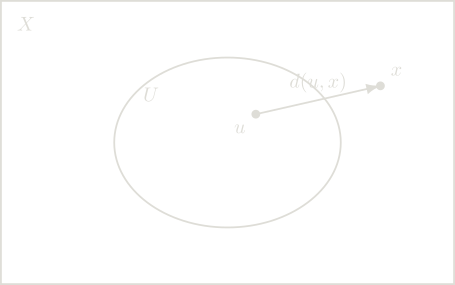
Next we will show that is closed, ie is open: this is immediate if is empty, so suppose it is nonempty and let . Now, build a cover of by taking , where . This choice ensures that even if the whole ball sticks out toward , every point in it remains more than away from .
We will now prove this. select and get the finite subcover , . now, let we claim that no is in . let , then for some , . thus, . ie, . since and we have .
Continuous Images and Closed Subsets
The following holds for any topological space: let be continuous, and compact. then is a compact subspace of .
Take an open cover of , take its pre-image under to get an open cover of , since is compact, you get its finite subcover, send it back by taking its image under , to get a finite subcover of .
lemma: let be a topological space, and a compact set. Then, if is closed, then is compact.
we know is open in the subspace . Take any open cover of , and extend it to an open cover of by adding . Take a finite subcover of , and discard if it was selected. what remains is a finite subcover of .
Notice that any point of with the usual metric is isolated in , and any point of is a limit point of itself. Ie is dense in itself.
4 - Ordered Fields and the Real Numbers
A field with an order on the set is said to be an ordered field if the field operations play nice with order:
- , implies
- , implies
ordered fields are cute, for example, as a field we know suppose , and of course (order is reflexive) thus we obtain by adding them together. now we can multiply two copies of that inequality, and get . together with , antisymmetry would give , a contradiction. (these things follow from field axioms)
that is in an ordered field.
an ordered set has the least upper bound property, or the supremum property, if any nonempty subset with an upper bound, has the least upper bound defined as follows:
let we say that is bounded above if for some , for any . Further, we call the least upper bound of if is an upper bound of , and for any upper bound of , we have .
We can analogously define lower bounds and greatest lower bounds, and the greatest lower bound property on an ordered set.
We define to be the ordered field which has the supremum property and contains as a subfield (up to isomorphism), and we will not bother constructing it. Further, it follows that has the infimum property as well, that is, any nonempty set with a lower bound, has the greatest lower bound.
If nothing is mentioned, we take the usual metric on .
lemma -1: let be nonempty and bounded above and . Then or is a limit point of (perhaps both). proof: suppose neither is true. well since is not a limit point of , there exists some such that is empty. ie, for each , (of course ). thus, is an upper bound of , a contradiction.
lemma 0: is closed.
proof: we will show is open. of course any point in is interior to it.
lemma 1: is bounded. (left as an exercise for the reader)
Compactness of the Unit Interval
Theorem. is a compact subspace of .
proof: This one is a banger. Let be an open cover of clearly, some contains . Of course then is interior to , ie for some , . so at least has a finite subcover. we would like to extend him :) (for example, in some and thus he is interior to , and …)
let . That is is the subset of whose closed interval starting at is finitely covered by sets in . is nonempty and bounded above, thus let . We claim . For contradiction, suppose . that is, is in some and is interior to it. thus, for some with , .
Now, if , then of course is finitely covered, and hence is finitely covered by taking union with . of course then is finitely covered, ie , a contradiction.
Otherwise, is a limit point of . thus, there is some with . Ie, is finitely covered, and taking union with , is yet again finitely covered, a contradiction.
Thus, . well cool, we still don’t know if , (if , we are done so suppose otherwise) but what we do know is that since for some guy in the open cover, for some , we have . since is a limit point of , there is some with . ie is finitely covered, and taking union with , is finitely covered.
5 - The Standard Topology on
Now, we will pause and gain some intuition on the standard topology (using the or whatever the usual metric) on .
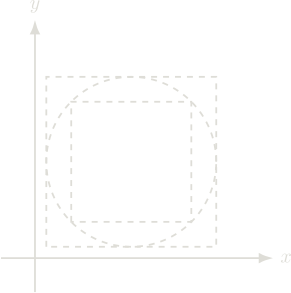
The projection of an open ball in onto each axis gives an open interval. Let us show this:
let be the projection map onto the -th axis. that is, where is the usual th basis.
let , and , we claim that .
First, let of course . Notice if , where thus, .
This means that . But of course, if , then . That is, .
thus, we have .
Now, we claim that . That is, the intervals obtained by projecting an open ball onto each axis, when taken product contain the open ball.
That is, .
As before, if then where is a unit vector and .
but of course (as a tuple), where as shown earlier. Thus by definition, .
And finally, we will show that there exists a SINGLE (this will help A LOT in showing continuity, I think) for which .
Indeed, if , then , that is
equivalently,
of course then, it is sufficient if , i.e. .
Okay, very nice. Now, we shall show a couple of things.
let , be a collection of open sets in we claim is open in
let , then by definition, , ie for some , let
then, , thus .
But as shown earlier, thus is interior to .
Similarly, if is open, each is open in .
suppose . then there is for which . Then for some , but of course then, . Equivalently, .
In we can thus denote the open box as , and equivalently, we can say that is open if and only if, for each , there exists some such that .
Compact Boxes
Theorem. is a compact subspace of .
We will proceed by induction, (notice we have already shown the base case) Suppose is compact, (up to isomorphism).
let and consider the set . Notice that the set isomorphism given by (concatenation) is continuous. Thus as shown earlier, is a compact subspace of .
Now let be an open cover of . of course, is an open cover of , and from that view, let be a finite subcover of .
since each is in some open set in , there exists such that the open box is contained in some set in . but of course, the collection of all such open boxes cover and thus, there is a finite subcover , moreover covers .
The nice thing with open boxes is, it lets us reason about each axis independently.
Any is in some . of course, where .
thus, .
That is to say, taking , is covered by and thus covered by . (note: the keen reader might yell at me saying hey or means the interval gets cutoff. if you like, you may take intersection with , or work in the ambient space)
Indeed, then for any open cover of and any , there exists some for which a finite subcollection of covers .
but of course, the collection covers , so it has a finite subcover , . The union of the corresponding finite collections is then a finite subcover of by sets in .
Now we get a bunch of stuff for free. For example, is a compact subspace of .
owing to the lemma from before it is sufficient to show that the map given by is continuous, (where and , and the multiplication is elementwise) for any real .
If , then is constant and therefore continuous. Otherwise, let , and let . Notice (the right hand side is Hölder’s inequality, which we shall show below) and thus .
Hölder’s Inequality
In , where the multiplication on vectors is elementwise. i.e. we must show
of course, we can square both sides, and show
for ease, let .
Notice
Now proceed by induction, (the base case is obvious) and suppose , of course .
The Heine-Borel Theorem
Theorem. Every closed bounded subset in is compact.
let be closed and bounded. Of course then, , and thus is a closed subset of a compact set.
Ie together, in , a subset is compact if and only if it is closed and bounded.
6 - Continuous Maps Between Real Vector Spaces
From our discussions earlier, it is quite clear that open boxes form an alternative basis, we further claim that if has the property that for each and any , there exists such that , then is continuous. This follows directly from seeing that if is open, then for any , we can take an open box around take its pre-image, which would contain the box around . In fact, this is an equivalent definition of continuity of .
we will use this to build a more workable, but equivalent condition to characterise continuous maps from any two real vector spaces.
Consider , we claim that is continuous if and only if each projection of , is continuous.
We only need to show one direction, as is continuous.
Now suppose each is continuous. fix and let . there exists some such that .
choose then .
that is, .
If a set is a subset of many sets, it is a subset of their intersection.
Thus, clearly, .
Now one might be tempted to say that having continuous for each and each fixed choice of the rest, means that is continuous. This is not true, we will provide many counterexamples later :)
The Reals as a Topological Field
We have special topological spaces, with some algebraic structure on them, for which the operations are continuous. (check algebra note)
we claim is a topological field.
we will show that the addition is continuous. Let ,
suppose then and . Now notice that .
Next we will show that the multiplication is continuous. let
now, suppose . first notice
that is, .
that is, repeatedly using and simplifying,
ie we demand to make this chill. and sufficiently, we can have
together, it is sufficient to take .
Now alarm bells might be ringing over your head, don’t worry! of course, after taking an ball around the ball around absolutely can depend on it!, of course it can’t depend on some point in the ball that isn’t the centre, because that doesn’t make sense, in order to specify elements of a ball, you must pick a radius, so that radius can’t depend on elements of the ball other than the centre. (which is common for all balls)
Finally, we will show that the inverse is continuous.
first notice (another variant of triangle inequality) thus . now suppose . then , ie
equivalently,
sufficiently, we want thus .
As shown in the algebra notes, thus the collection of continuous maps from any topological space to the reals form a ring under pointwise addition and multiplication. (the maps which do not take zero values are closed under pointwise multiplication and inverse, but not under addition, so they do not form a field.)
as a Topological Vector Space
Next we shall show that (over ) forms a topological vector space, that is, addition and scalar products are continuous. (of course using the product topology wherever it’s ambiguous)
This follows directly, notice that has each projection continuous, (this is the addition in reals) similarly, the scalar multiplication has each projection which is continuous (multiplication in reals).
That is, the collection of continuous maps from any topological space to form a vector space over , with pointwise addition and scalar multiplication.
7 - Sequences
a map where is a metric space is called a sequence.
we say is cauchy if its terms get arbitrary close, taking a far enough tail. That is, for each , there exists for which whenever , we have .
We will denote the -tail of a sequence by . A subsequence of is obtained by selecting terms along a strictly increasing map . It is given by , and will be denoted .
we say for some , converges to and write when for each , there exists for which , that is a tail that is -close to .
next we claim that the following two statements are equivalent:
- converges to .
- is cauchy and, is eventually constant at or is a (THE) limit point of .
: is cauchy: we know that a tail of is close to for any , thus by the triangle inequality, that same tail is close to each other.
now, if is eventually constant at all balls (WITH CENTRE LOOK AT THE DEFINITION OF CONVERGENCE) at least contain the constant -tail.
Now for any some -tail is in the open ball (with centre included), since the sequence is not eventually constant at there is an infinite subsequence of this tail contained inside the open ball that are NOT equal to ! thus the ball without centre has a nonempty intersection with thus is a (THE) limit point of .
: I mean if something is eventually constant at then of course it converges to .
suppose is a limit point of , the intuition we have is that is cauchy, meaning tails are eventually close to each other, and further that for any some subsequence (infinite ofc) is close to .
somehow we want to put these together to show that tails are close to .
well, suppose there is a pathological for which no tail is fully contained inside the ball, that is to say, the set of such that has no maximum element. (if it did, you could take the tail beyond that point)
similarly, given that is a limit point, the set of for which has no maximum element either.
that is to say, in the tail that is close to each other, you will find both kinds of elements and then you can take the triangle inequality to show that that shit is a contradiction.
further you can show that if and then .
suppose . take balls around and . a tail is fully contained in one ball, and a tail is fully contained in the other ball. well one of them is a subtail of the other one, so we have a tail contained in two disjoint sets, which doesn’t make sense.
Convergent Subsequences in Compact Spaces
Now, we claim that if is a sequence into a compact metric space, then it has a convergent subsequence.
Let . Take . Cover by open balls and take a finite subcover. Given that has no maximum element, some ball in this finite subcover has the property that
has no maximum element. Indeed, if each of these sets had a maximum, then their finite union would have a maximum.
Thus, by induction, we have a sequence of nested sets
such that has no maximum element and, whenever ,
Pick . Having picked with , we can pick such that , since has no maximum element.
Let be given by . We claim that the subsequence is cauchy. For any , take such that . If , then , and hence
If is finite, then is eventually constant. This is immediate if its image has one point. Otherwise, take smaller than the minimum distance between two distinct points of its image. A -cauchy tail can contain only one point.
Suppose instead that is infinite. We claim that it has a limit point in . Otherwise, for each , there is an open ball such that
The balls cover , so take a finite subcover. Each ball in this finite subcover contains at most one point of , which would make finite, a contradiction.
Thus is cauchy and is either eventually constant or has a limit point. By the equivalence proved above, it converges.