Algebra - 0
Uploaded Last edited
This is the first in many notes as I read Algebra: Chapter 0 by Aluffi
The central idea in this entry is to motivate categorification. We will look at structures in two settings: sets and functions, and groups and group homomorphisms. Categorification means stating a structure purely in terms of how morphisms interact with each other; that is, making the structure object-agnostic.
We will see that this is not always possible. Certain morphism interactions in particular categories, such as or , are derived from properties of the objects themselves. In such cases, we can define special properties on a category, so that having that property forces those morphism interactions to hold.
We start with Russell’s paradox, which highlights issues in naive set theory. Nevertheless, the ZFC axioms solve this, and one axiom we care about is choice, which we will state and move on to build up to the first isomorphism theorem of groups, which we will attempt to categorify in later notes picking up ideas from set theory to motivate definitions
0 - Set-Theoretic Foundations
Russell’s Paradox
Suppose you allow sets to be described by arbitrary predicates: for example, let be the set whose elements are any sets that do not contain themselves, i.e. . It is clear that , creating a contradiction.
Axiom of Choice
Let be a collection of nonempty sets. Then there exists a function such that for all . Such an is called a choice function: it “chooses” one element from each set in the collection. The axiom of choice asserts that this is always possible, even when is infinite and there is no explicit rule for making the choices.
1 - Aluffi I, Exercise 1.6
The first interesting problem we see is as follows: 1
On , define a relation if . Show that this relation is an equivalence and find a compelling description for it.
It’s quite obvious that the relation is an equivalence; the part that interested me was the “compelling description.”
My first idea was as follows: let be a group, and an equivalence relation on that is compatible with , that is,
Define the operator for classes in . Then is a group, and moreover the projection given by is a homomorphism.
Proof: It is rather obvious that the operator on is closed and associative. Moreover, it is clear that is the identity, and that the inverse of is (all of this follows easily from our definition of the product). Even being a homomorphism follows directly, as
On my first attempt at this exercise, I missed the compatibility condition. We need it for the operator to be well defined.
The operator says: “the product of two equivalence classes is defined as the equivalence class of the product of any two representatives.” For this to make sense, the result must not depend on which representatives we choose. That is, if and , we need , i.e. . This is exactly the compatibility condition, and without it, the operator on isn’t actually well defined.
It’s not hard to see that the relation given in the exercise satisfies this condition: and is equivalent to saying for which . Clearly, , which means that .
Now, notice that . Trivially, is an isomorphism from to , with addition given by and the zero element here is just . But this doesn’t tell us anything about the structure of with respect to the ambient group .
Another thing we can notice is that is a subgroup of , and our equivalence relation says .
So we would like to, in general, inspect for a group and a subgroup , the relation The closure of lets us easily prove that the above relation is an equivalence.
Suppose and . Then , which means ; that is, , showing transitivity.
Of course, , as .
Now, is closed under inverses. Thus, , and therefore ; thus, .
Now, if we want to be a group, with the natural product between equivalence classes, the above relation must be compatible with the group operator. That is, we want and to imply .
In particular, we want .
Let and . Then
Since , it is sufficient for to be in .
Now, we first notice that pairs for which cover all of (set and ). Thus it is sufficient to have, for any and any ,
Notice that forms a subgroup of . If the above condition holds, then (it is a subgroup of ).
Also, since the above condition holds for any , we have .
We want to show that , that is, for each there exists some for which . Equivalently, , i.e. , thus .
Thus, together we have for any . Such subgroups are known as normal subgroups.
In particular, we have that for any , the relation on makes a group with the natural product of equivalence classes if and only if is a normal subgroup of . And of course, in this case, the map is a group homomorphism.
To extend this, we shall show that is a normal subgroup if and only if for any in the ambient group.
That is, as equality of sets: for each there exists some for which , i.e. . In particular, this means , that is, . Similarly, one can show that (using a similar argument as above)
Conversely, suppose is normal, that is, for every .
Then for any , we have , so for some , that is, . Since was arbitrary, .
Similarly, applying normality to , we get , so for any , for some , that is, . Since was arbitrary, .
Together, .
Thus is normal if and only if for all .
Now, consider all the left cosets of a subgroup of , often denoted . We may put the operator .
In fact, there might be many whose cosets are all equal, this brings forth an analogous well-definedness issue: suppose and , then we want . We claim that this is possible if and only if is normal.
() Suppose the product is well defined. Take , . Then , so holds. Now take for any , so trivially . Well-definedness gives .
Since and were arbitrary, this says for every , (as ). That is, for all , and by our earlier argument this forces to be normal.
() Suppose is normal. Then and give
Thus , as required. Our intuition is starting to tingle here. We feel as though, when is normal, the quotient , where , with the natural product, is isomorphic to (with the product defined above). In fact, if you look at the relation in Example 1.6, each equivalence class is an isomorphic copy of the subgroup , shifted by some .
A natural choice is to send , and more generally . But again, we must check that this function is well defined, as implicitly picks a representative of .
Well-definedness. Let ; we claim . Notice , that is, . Since is normal, , so , thus , and therefore . Thus the function is well defined.
Homomorphism. We shall show it is a group homomorphism. Notice that .
Bijectivity. We claim the map is also bijective. Suppose . Then , i.e. , therefore , i.e. , and thus the map is injective. Surjectivity is obvious. Now you might be asking me, where are the commutative diagrams? Here is one:
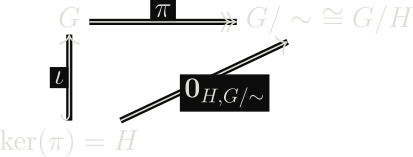
We shall call this the first baby isomorphism theorem (we will see later why).
Theorem (Baby isomorphism theorem): Let be a group and a normal subgroup of . Then the equivalence , with product , is isomorphic to , the quotient group: the set of left cosets over with product . Moreover, the kernel of the canonical projection is . The trivial map , given by for all , is factored by the inclusion of into followed by .
Proof: The isomorphism part is proven in the discussion above. Now, we shall prove that . Notice that means that ; that is, . Of course, . Now, we shall prove that is . This is also obvious, as .
First Isomorphism Theorem
Now, there is quite a bit of tingle in our balls. Indeed, in the above diagram, the map is surjective, and from set theory, we know that a function can be factored as a surjective map to its image, followed by the injective inclusion into the codomain. Here, is itself acting as the image of the homomorphism. However, nothing is stopping us from factoring a homomorphism into a surjective map onto its image followed by an inclusion, and naturally, the first isomorphism theorem arises.
+First isomorphism theorem of groups. Let be a group homomorphism. Then is a normal subgroup of , and
More explicitly, we can define the surjective homomorphism
where the only difference between and is that the codomain of is restricted to the image of . If is the inclusion, then factors as
Moreover, is precisely the part of that sends to the identity. Let be the inclusion and let be the trivial homomorphism, given by . Then the zero map factors as
Thus the following diagram commutes:
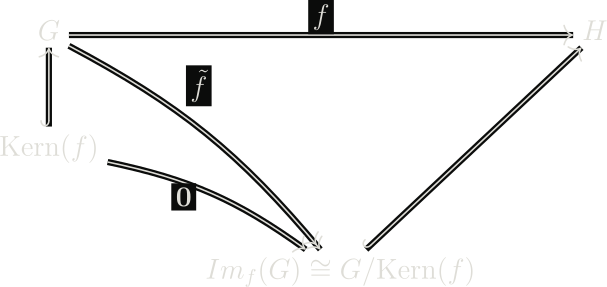
Proof: First, we shall prove the isomorphism between and .
We shall first show that is normal. Let , and set . Then which means .
Now suppose . Then . Multiplying on the left by and on the right by , we get , i.e. .
Let be given by . is well defined, as whenever , we have ; that is, , and thus , which means (every coset has a unique image under ).
Injectivity. Suppose , i.e. , i.e. , thus . This is equivalent to saying (left coset action on elements of the subgroup leaves it unchanged). Given that is normal, , that is, . Thus is injective.
Surjectivity. Let , and let be any element of (the preimage). We claim that for any choice of , . In particular, it is enough to show that the coset is the same for all choices of . Let ; then . Ah, but this means , which means . Rehashing the argument used above, we then have . Indeed, is well defined, and it is equal to .
Cool, is a bijection. Now, to show that is a homomorphism: Notice that (due to the definition of the product on ), which is . We shall omit showing that the remaining functions in the above diagram are homomorphisms and that everything commutes (trivial).
2 - The Circle Group
Finally, to milk this exercise dry, we shall show that the original group in the exercise is isomorphic to the circle group , which can be given by multiplication of complex numbers on the unit circle.
Consider given by .
is a homomorphism. For any ,
is surjective. Any can be written as for some , so taking gives .
. We have if and only if , which holds if and only if .
By our earlier result, induces an isomorphism . Since and is surjective onto , this reads given explicitly by . This is precisely the compelling description we were after: the quotient is the circle, glued together by wrapping the real line around at integer-spaced points.
Footnotes
-
Aluffi, Algebra: Chapter 0, Ch. I, Exercise 1.6. ↩