Groups
Uploaded Last edited
0 - Magma, Semigroups, Monoids, Groups
Definition (Magma): A set with a map is called a magma. The map is called a binary operator (or just operator), and for , we write as , and often shorten it to just . Note that is called the product of and .
A binary operator of a magma is associative if . In this case we can use induction to show that the product of elements can simply be written , and any parenthesizing of this product is equivalent.
A binary operator of a magma is commutative if . It is customary to use additive notation in such cases, that is we often denote as , when is commutative.
Definition (Identity element): let be a magma. an element is called the identity element (or just identity) if for every , . Note that the identity of a magma is unique. Otherwise, suppose is also an identity of , then .
Definition (Semigroup): A semigroup is a magma whose operator is associative.
Definition (Monoid): A monoid is a semigroup with a (unqiue) identity.
Definition (Group): A monoid where each element has an inverse such that is a group. A group is abelian if it’s operator is commutative.
Proposition (Uniqueness of inverses): Let be a group, then for each , there is a unique such that .
Proof: Suppose both are inverses of an arbitrary element . Then, multiplying on boh sides, we get . Therefore, .
Proposition (The unique property of the identity): let be a group, then the identity is the only element in such that
Proof: Suppose for some , we have that . Then, multiplying by on both sides, we have .
Proposition (A one way condition to guarantee abelian groups): let be a group, such that for each , , then is abelian.
Proof: let be arbitrary elements in . Then, . Hence there is a unique , such that . Using the algebraic properties of groups, it is not hard to see that . However, its given to us that . which means that (they are “both” the unique inverse elements of ). Equivalently, . Again, in , . Hence, and . Therefore, , hence is abelian.
To show that this condition is only one way, consider the group of integers with addition as the operator, . This group is abelian, however, it is not true that for each .
Proposition (Left identity + left inverses suffice): let be a semigroup, such that there exists such that for all , and for each , there exists such that . Then is a group.
Proof: we play some algebraic tricks here: Let , then . Consider the equation . Notice that (every element has a left inverse). Now, . Hence, upon simplifying, we have . Hence is also a right identity, therefore, is the identity. Similarly, . Hence, . Upon simplifying, we have . Therefore is also the right inverse and hence the inverse of .
Proposition (Right identity + right inverses suffice): Give a proof, symmetrical to the one above.
Proposition (Finite semigroup with cancellation is a group): Let be a finite semigroup, , such that implies and implies . Then is a group.
Proof: for an arbitrary element , consider the map , given by for all . This map is injective, as implies . Hence, each goes to a unique . therefore, the image of under has exactly elements, Hence , therefore, the map is bijective. hence, there exists a unqiue such that that is . Now consider an arbitrary element . notice that . Hence . therefore is the left identity. moreover, (e is the left identity) Hence, therefore, is also the right identity. Now, for an arbitrary element the map as described above is bijective, so there is a unique such that . Equivalently every element has a unique right inverse such that . We finish the proof by applying the proposition on right identity + right inverses.
Product of Groups
Definition (Direct product of groups): Let be a collection of groups. Then, the set with the product of two tuples and , where . Is given by is called the direct product of a collection of groups.
Proposition (The direct product of groups is a group):
Proof (outline): Associativity of the product defined above, follows directly from the associativity of the products of each group . The tuple of identity elements from each group acts as the identity element, and for the arbitrary element , the inverse element is given by .
1 - Maps on Groups
Definition (Group homomorphism): let be groups and be a map. is a group homomorphism if for each , .
furthermore, we will suppress any notation to indicate that is a product in and is a product in .
Proposition (Properties of homomorphisms): For the following discussion, let be groups, with identities and and a homomorphism from .
- (under a homomorphism, the image of the identity of the domain group, is the identity of the target group).
- for each , is where is the inverse in .
- Let all be groups, and let be a homomorphism from to , a homomorphism from to , then is a homomorphism from to .(the composition of homomorphisms, is itself a homomorphism).
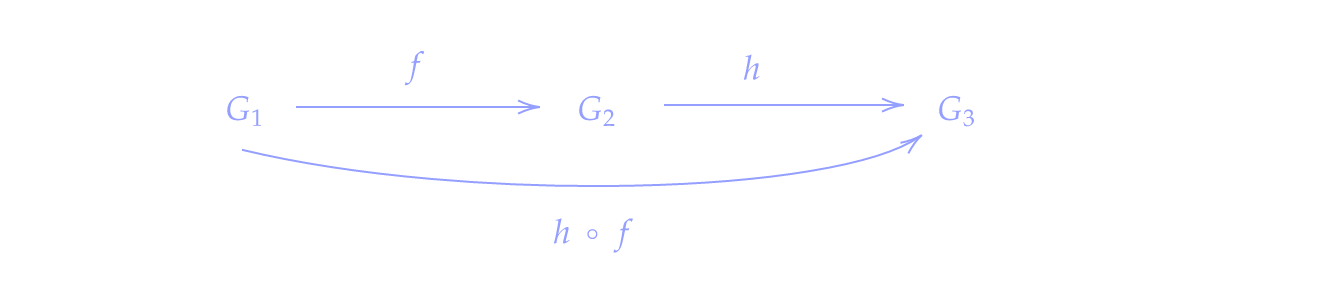
Proof:
- We will use the unique property of the identity element of a group. Notice that . Hence it must be that .
- Notice that for any , but . Therefore, Hence is the unique inverse of in . In notation, .
- let be arbitrary elements of . Then, .
Definition (Group isomorphism): let , be groups. a map is an isomorphism, if it is a bijective homomorphism. An isomorphism from onto itself is called an automorphism.
Proposition (The inverse of an isomorphism is an isomorphism): if is an isomorphism, then is an isomorphism, where are groups.
Proof: The inverse of a bijection, is also a bijection. Hence, it is sufficient to prove that is a homomorphism. let be arbitrary elements of . Then, since is bijective, there exists unique such that . hence . Now, . Hence is a homomorphism.
Proposition (Automorphisms form a group): Let be a group, and let be the collection of all automorphisms on . Then this set, with map composition as the operator, forms a group.
Proof: notice that the identity map from to is an automorphism (it is both bijective and homomorphic). And acts as the group identity under composition. for any two maps . Then is bijective, moreover by the properties of homomorphisms, is a homomorphism, hence . Associativity follows as a property of function composition, and since the inverse of an isomorphism is an isomorphism, for each , : the inverse map, acts as the group inverse element.
The Left Coset Map
Definition (Left coset maps): Let be a group, and an arbitrary element of . then the left coset map is the map for each .
Proposition (Left coset maps are bijective): Let be a group, and be the collection of left coset maps from to . Then, every element is a bijection on .
Proof: Let be an arbitrary element of . We claim that is a bijection. suppose for , . Then, hence , showing injectivity. Now, suppose is an arbitrary element in . Notice that . Showing Surjectivity.
Theorem (Left coset maps form a group isomorphic to ): Let be a group, then the collection of left coset maps is a group under map composition. Moreover, is isomorphic to .
Proof: The identity map on is for all , is the group identity as for any . Associativity follows as a property of map composition, of course, the composition of two left coset maps . is , because for all . Hence, is closed under composition, moreover the map is a homomorphism, as . For each the unique is given by . This is because for each , . Hence . We claim that the map is bijective. Surjectivity is obvious. now suppose that then for each , hence . Hence we produce the desired isomorphism from to ).
Lemma (Distinct left coset maps never agree): Let be a group, and be two distinct left coset maps. Then there is no such that . Otherwise, this would imply that hence (multiplying on both the sides), meaning that and are identical maps.
Warning: A left coset map is NOT a homomorphism. Let be a group. Then a map if then is not a homomorphism from to . , . Even if is abelian, and only if . See the unique property of the identity of a group.
2 - Subgroups
Definition (Subgroup): let be a group, then a subset of is a subgroup of if it a group, inheriting the operator from . In such a case we write . if , we write .
Proposition (Necessary and sufficient conditions for subgroups): let be a group, , a subset of is a subgroup if and only if the following properties hold:
- The identity is also in .
- implies that ( is closed under the product operator inherited from ).
- implies that ( is closed under inverses).
Proof: if is a subgroup, 1,2,3 follow by definition. Now suppose . Then the above three conditions guarantee that is a group, with associativity following from inheriting the operator from .
Theorem (A simpler subgroup condition): let be a group, and a subset of . then is a subgroup if and only if is non empty, and implies .
Proof: Suppose was a subgroup of . then obviously, is non empty (it at least contains , the identity) and implies . Now, suppose was a non empty subset of , and that implies . We will show that : notice that implies . Now we show that is closed under inverses: Since , for any element , . Finally, we will show that is closed under products: Suppose . Then , (as shown earlier). Hence . Hence . Therefore by the necessary and sufficient conditions above, is a subgroup of .
Proposition (Intersection of subgroups): Let be a group, and be subgroups of . Then, is a subgroup of .
Proof: since is in both and , is non empty. Suppose . Then is in both and . Therefore, is in both and . Hence, . Apply the simpler subgroup condition.
Theorem (Intersection of finitely many subgroups): Let All be subgroups of a group . Then, is a subgroup of .
Proof outline: Use the intersection of subgroups proposition with a natural induction argument.
Theorem (Finiteness + product closure suffice for subgroups): Let be finite subset of a group , such that the identity . If implies , then is a subgroup of .
Intuition:
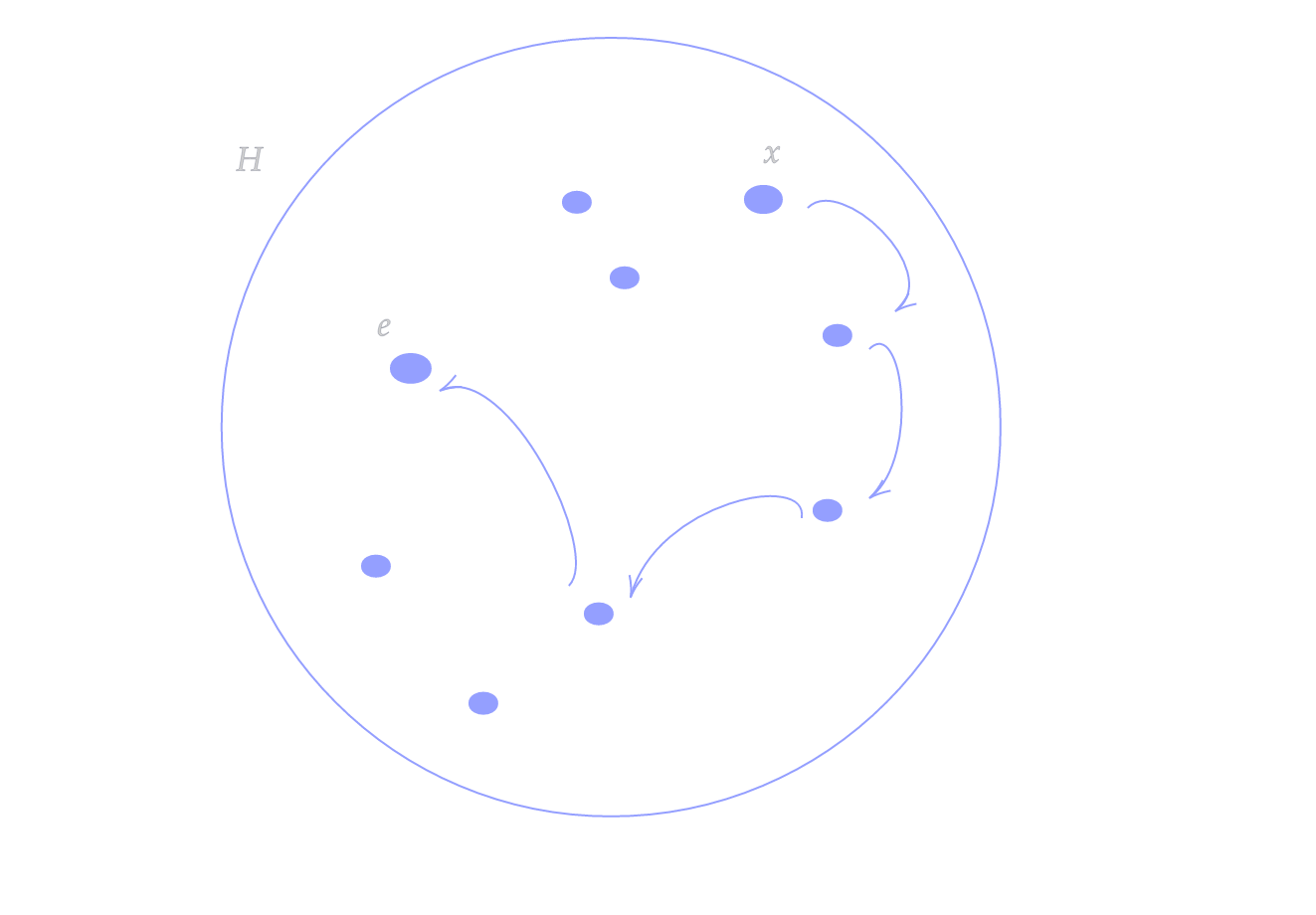
Imagine a finite set , closed under products, with the identity element in it. Starting from an arbitrary element , start taking left products, , and so on… each of these products are the images of under distinct left coset maps. so eventually, we have to hit , (we will show that we can’t loop around without ever hitting ), basically allowing us to get closure under inverses.
Proof: Since is finite, let , we can index the elements of . We claim that the left coset maps are well defined from to . suppose and . then due to product closure. Now, Consider the set of orbits of under each map in defined as . By the lemma on distinct left coset maps, if , then in which has inverses, meaning that they are the identical left coset map in , Hence, they are identical in . Therefore has distinct elements, each of which lie in . Hence , given that is finite. Since there exists some such that . This is the inverse of an element . Hence is closed under inverses. Apply the necessary and sufficient conditions for subgroups.
3 - Fibers, Kernel, Conjugation, Centre
Definition (Fibers, Images): note: This term is inherited from category theory, where it carries more meaning. But in our case, it’s just a fancy word for the inverse image of set over a map.
let be groups and be a map, then the fibers of over is the set .
The image of a set is the set .
Definition (Kernel): let be groups and be a map. Then the kernel of , is the fibres of the identity . that is, .
Definition (Conjugation, Normalizer): let be a group, and a subset of . Let be any particular element of . Then the conjugation of with is the set .
The normalizer of , is the set of all for which the conjugation of with is equal to itself. That is, .
Proposition (Kernel is a subgroup): Let be groups and a homomorphism. Then, .
Proof: We will use properties of homomorphisms for the following argument. Notice that hence .
Now suppose then . Hence (see: the unique property of the identity element of a group). But, is a homomorphism. Hence, . Therefore, .
Now, suppose , then consider the equation . Since is a homomorphism, we obtain . But, . Therefore, hence .
Proposition (Image is a subgroup): Let be groups and a homomorphism. Then, .
Proof: First, notice that is non empty, as , hence . Now, suppose . Then, as . Similarly, if , then as . See: properties of homomorphisms.
Proposition (Conjugation of a subgroup): Let be a group, and be a subgroup of . then for any element , .
Proof: Since , .
Now, suppose . Then for some , and . Therefore, , hence .
Now, suppose then for some . (The reader is asked to pause and carry out the product and , should any doubt arise). Finally apply the necessary and sufficient conditions for subgroups.
Proposition (Normalizer of a subgroup): Let be a group, and a subgroup of , then, .
Proof: We will begin by showing that is a subgroup of :
. Clearly, is non empty as . ().
Suppose . then . Notice that . Therefore, .
Now suppose that , then . But . Hence, , therefore, . Hence .
Finally, apply the necessary and sufficient conditions for subgroups.
Now, we will show that is a subgroup of .
Of course is a group, so it is sufficient to show that . For any , but is just the image of the left coset map on given by for all . That is, is just notation for . But left coset maps are bijective. Hence, .
Therefore, we have . Using a similar argument, Where is the right coset map induced by . Analogously, right coset maps are bijective too. hence .
Finially, this gives us . Therefore, any is also in .
Definition (Center of a group): The Center of a group , denoted by , is the subset of whose all elements commute with the entirety of . That is .
Proposition (The center is a subgroup): Let be a group. Then, .
Proof: Since , is not empty. Let . then for all , and . But, . Hence Hence . Now, if , and , then . Hence, hence . hence .
4 - Examples of Groups
The Klein-Four Group
A way to generate the Klein-Four Group: Notice that except the identity permutation , every other permutation, can be written as the composition of two independent swaps. Let denote the permutation And leaves everything unchanged. Then, , and, . Furthermore, notice that . and and so on…
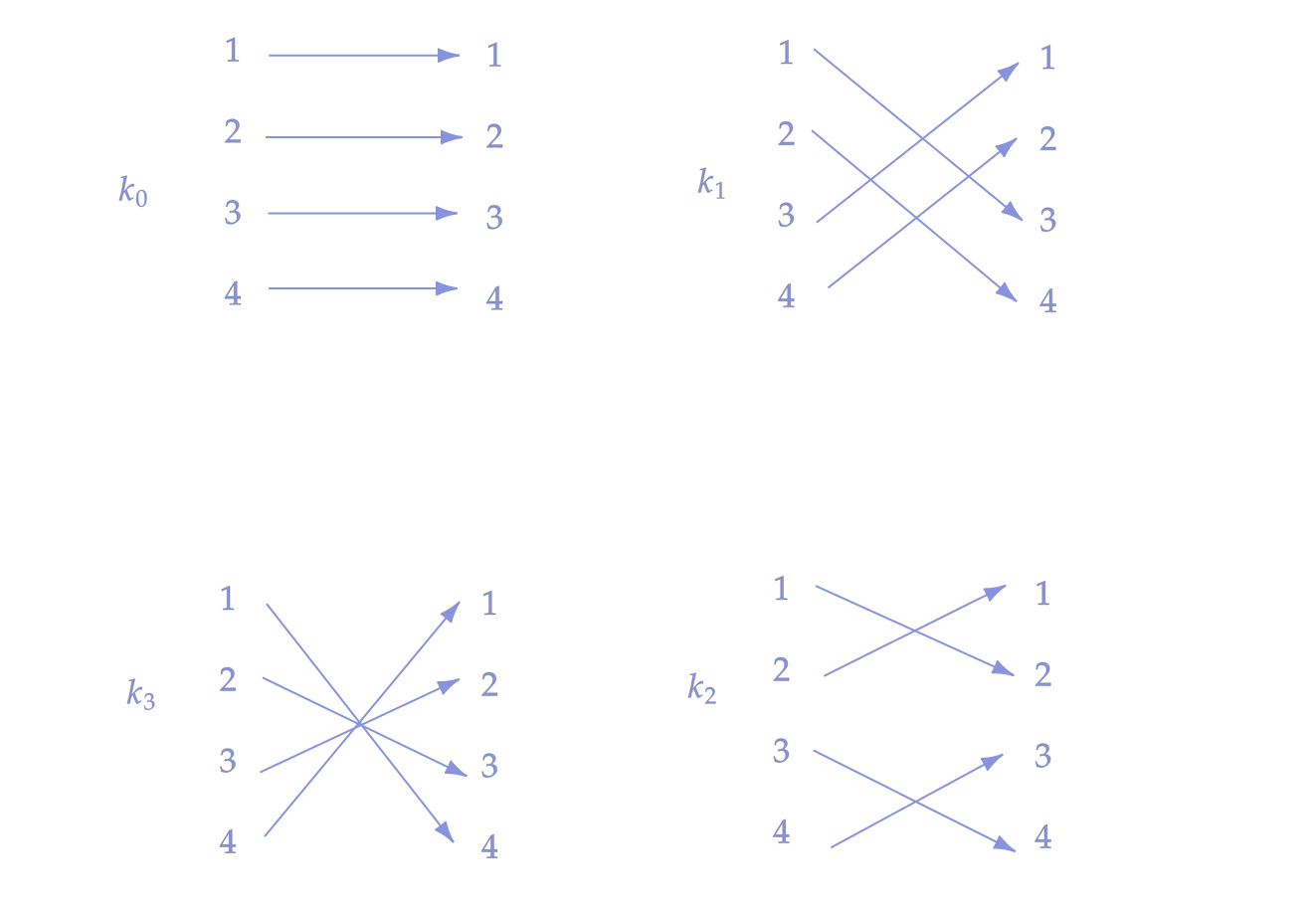
Definition (Klein-Four group): The set with and , , as the products is called the Klein-Four group.
The Dihedral Group
A necklace for a group: Below, we depict two necklaces, one on a rigid triangular wire, and one on a rigid square wire. We can imagine distinctly colored beads on each vertex. The question then is, how can we manipulate the necklace, so that when you place it on the table and take a picture, it looks different in the arrangement of beads? call the “do nothing” transformation . Then, call the counter-clockwise rotation by (for a regular -gon), . Then every rotation of the necklace is given by . Where .
Now notice that you’ve got a “front” of the necklace and “back” of the necklace. And to get to the back of the necklace from the front, you would reflect it about an axis, say call that . notice that two reflections about the same axis is equivalent to “doing nothing”. .
And by observing this picture more, one can work out all the other products. Two reflections should be a rotation, because you come back to the “front” of the necklace, and so on…
A rotation, then a reflection leaves you in the “back” of the necklace, so it should be equivalent to a reflection about some axis…
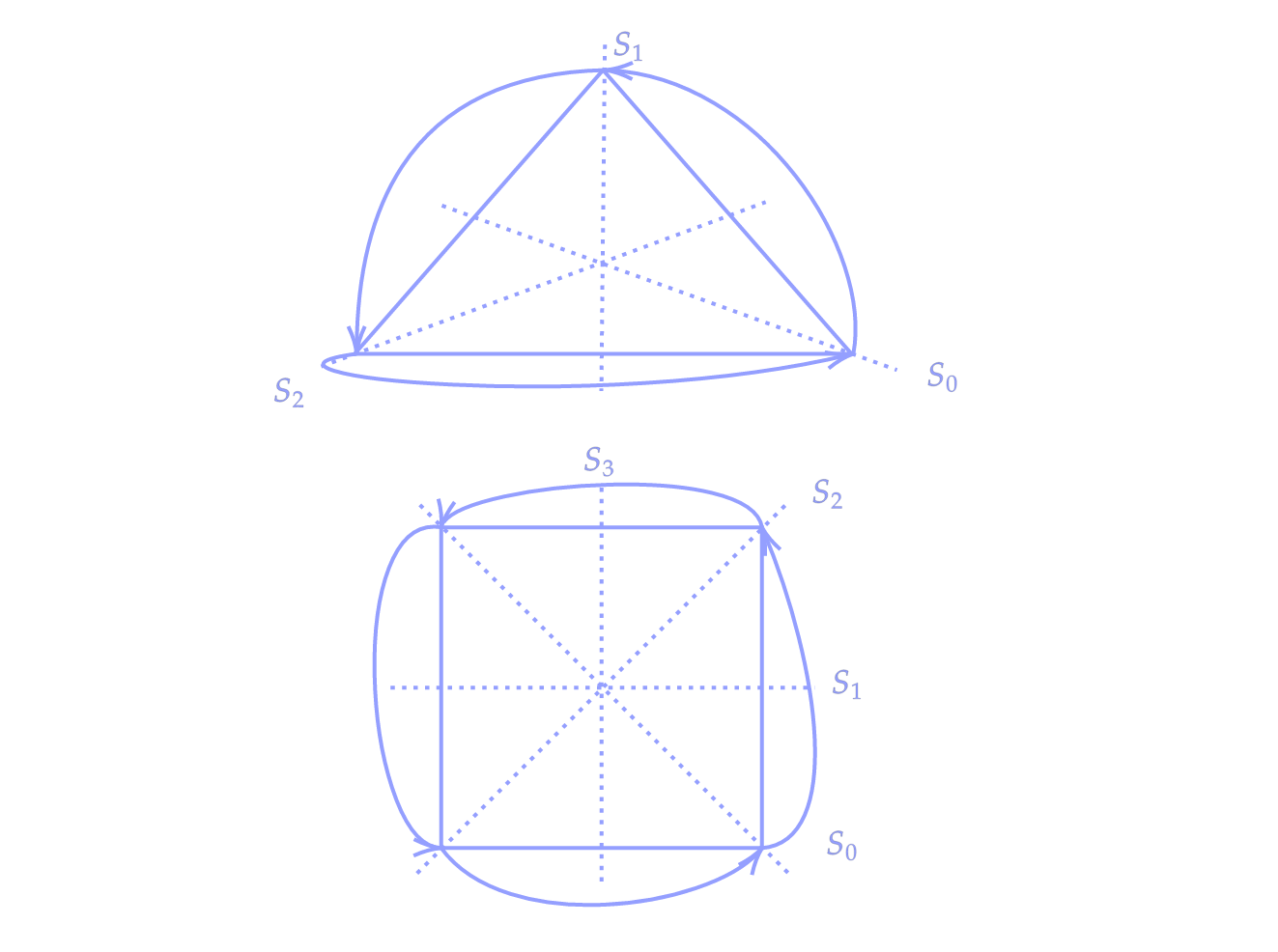
Definition (Dihedral group of a regular -gon): The set with the following products:
The Additive and Multiplicative Groups on the Reals, The Circle Group
Definition (Additive and multiplicative groups on Reals): The set with addition forms an abelian Group. The set with multiplication forms an abelian group as well.
The map is the desired isomorphism from to
Definition (The circle group): In the complex numbers , the unit circle is an abelian group with complex multiplication.
is the desired homomorphism from to . if is restricted to , then the given map is an isomorphism.
5 - Generators, Cyclic Groups
Definition (Containment of a subset): Let be a group and be a subset of . Then a containment group of , denoted by is the collection of subgroups of such that . That is .
Now, Notice that any has the following properties:
- Since contains , for each , .
- For any , and , the product .
- Putting it all together, for any , contains the element where or .
Now, define . From the above discussion, it is clear that for each . Moreover, of course . We show that is a group (precisely it is a subgroup of ).
We will repeatedly abuse the definition of (note that a definition is not a person so this is okay) for the following proof.
- : pick any . Then, by defenition, it is clear that .
- Suppose Then and for some , such that and . Hence, .
- Suppose Then , for some such that . Then .
Hence, each contains the subgroup . Therefore, is the smallest group that contains , known as the subgroup generated by . In particular, for each , .
Definition (Group generated by a set): let be a group, and a subset of , then inheriting the operator from , the subgroup of generated by , is the set .
Definition (Cyclic group): For a group , the group generated by any element is denoted by . This group is called the cyclic subgroup of generated by .
Notice that just contains the products of with itself : and the products of with itself: , where . The smallest for which is (if it exists) known as the order of .
In such a case, it is clear that . where .
Otherwise, if no such exists, the order of is infinite.
The order of an element of a group is the order of its cyclic subgroup .
Two cyclic groups of the same order , are isomorphic to each other, where is the desired isomorphism.
Moreover, a cyclic group of finite order, say is isomorphic to the rotations of a regular -gon.
Proposition (Necessary and sufficient condition for a cyclic group): Let be a group. Then is cyclic if and only if, there exists , .
Proof: Suppose is cyclic, then by definition there exists an element such that . Now suppose that there exists such that , then by definition, is cyclic.
Although the above proposition seems to bash on the obvious, it’s extremely useful: for example in showing that the multiplicative group of integers, modulo a prime is cyclic.
6 - Symmetric Groups
Definition (Symmetric group): Let be a set, then the set of all bijection on , with function composition as the operator, is a group, called the symmetric group on , denoted by .
Here, the identity map acts as the group identity, with any .
The inverse function acts as the inverse element of each .
Associativity and closure follow as properties of composition of bijections.
Theorem (Set cardinalities categorize symmetric groups): Let and be sets, such that the cardinalities of and are equal. Then is isomorphic to
Commutative Diagram:
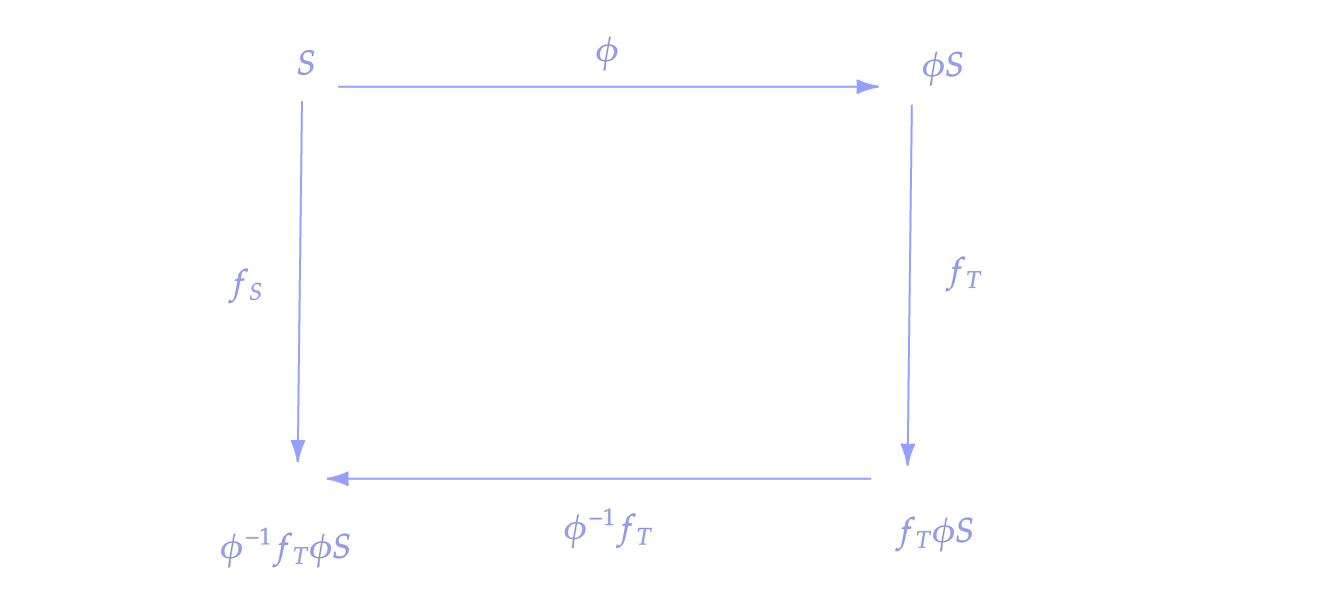
Proof: Let , be sets with equal cardinality, and be a bijection. Moreover, let denote a bijection on , and denote a bijection on .
By observing the commutative diagram above, we see that for every there exists an such that . Note that this indeed a bijection on , because the composition of bijections is a bijection.
Hence we claim that the map is an isomorphism from to .
Homomorphicity:
Surjectivity: Let be an arbitrary element of , then we have That maps to .
Injectivity: let Then due to the properties of bijections, .
Theorem (Cayley’s Theorem): Let be a group, then is isomorphic to a subgroup of symmetric group on the set , .
Proof: Because left coset maps of a group are bijective, they are a subset of . Because left coset maps on a group are isomorphic to the group itself, is isomorphic to a subgroup of .
https://www.youtube.com/playlist?list=PLA7B08F1D8252DE29 I am planning on writing a sequel with really key ideas of group theory that I have missed here.