Algebra - 4
Uploaded Last edited
0 - The Coproduct Topology
Imagine you had two topological spaces .
If are disjoint, would the union be a topological space? if not, what topology should we put?
notice that has a problem, pick two open sets say since are disjoint, is in neither topology.
instead, build .
notice that the above topology contains both (by way of choosing U or V to be the emptyset)
Claim. is a topology on .
: take for the first, for the second.
Arbitrary unions. Let be a collection of sets in , , . Then
just rearranging the union. Since and (each a topology, closed under arbitrary unions), the whole thing is again of the form , hence in .
Finite intersections. It suffices to check two sets, and . Then
Since are disjoint, and (one lives in , the other in ). So this reduces to
and , , so this is again of the form , hence in .
So is a topology on .
somehow, this is the “natural” topology. In what sense? we know that the inclusion maps from into under this topology is of course continuous. (is this the finest topology with that property?)
The answer is YES! let be some topology on for which both the inclusion maps are continuous, now, let , we know and . but of course since are disjoint we have which is a union of open sets one in and one in which gives us implies .
It seems like “the finest topology such that something something” gives us some sort of universal property. lets explore that.
first of all, notice that if is not empty, you can instead use the disjoint union and the same construction from above.
now, we claim the following:
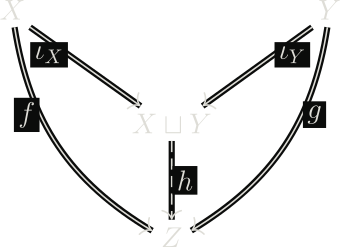
is the coproduct: given any with continuous maps , , there exists a unique continuous with and .
It is obvious that if , if , is the unique candidate satisfying and , since these two conditions force ‘s value on every point of .
Note: isn’t literally inside , it’s an isomorphic copy, tagged so it can’t collide with even if they originally overlapped. Concretely, , so , .
Now show that is continuous.
Let be open. We want open in , i.e. of the form with , (under the tagged inclusions).
Since , a disjoint union,
On , agrees with (i.e. ), so , and is open in since is continuous. Similarly , open in since is continuous.
So is the union of an open set of and an open set of , hence open in by definition of the co-product topology. Thus is continuous.
1 - Co-cones, Limits, and Colimits
That is, its the “co-limit” over that type of diagram, we have the category of cones as a special case of the comma category, we want “co-cones”
Recall: a cone over with apex was the comma category , where is the diagonal functor, and picks out the fixed diagram .
A co-cone under should be the dual picture: instead of maps from a constant diagram into , we want maps from into a constant diagram. So we just flip which functor sits on which side of the comma:
Objects here are triples , that is, pairs , a natural transformation from into the constant diagram at , exactly a co-cone with apex : componentwise, for each , with the analogous compatibility condition with ‘s own morphisms.
Morphisms of co-cones follow the same pattern as before, mirrored: a morphism is such that , unpacking componentwise to for every .
Definition (Initial and terminal objects). Let be a category.
An object is initial if, for every object , there exists a unique morphism .
An object is terminal (or final) if, for every object , there exists a unique morphism .
Both are unique up to (unique) isomorphism, when they exist: if are both initial, the unique maps and compose to the unique map , which must be (by uniqueness of maps ), and similarly the other way, so ; dually for terminal objects.
Initial and terminal are dual notions: an initial object of is exactly a terminal object of .
Definition (Limit and colimit). Let be a diagram.
The limit of , denoted , is the terminal object of the category of cones over , that is, the terminal object of the comma category .
The colimit of , denoted , is the initial object of the category of co-cones under , that is, the initial object of the comma category .
Both are unique up to unique isomorphism, being terminal/initial objects.
2 - Pullbacks and Pushouts
Products and co-products in a category are limits and co-limits over the diagram , two objects, no morphisms between them.
A pullback, pushforward, is the limit/co-limit of the following diagrams respectively:
The diagram over which the pullback is a cone is the cospan :
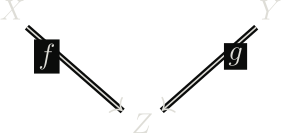
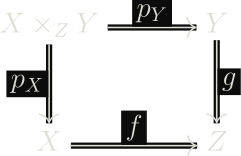
Its pullback is the terminal such cone, giving the pullback square:
The diagram under which the pushout is a co-cone is the span :
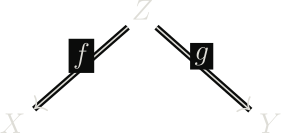
Its pushout is the initial such co-cone, giving the pushout square:
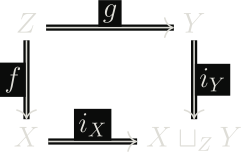
note: The original intention, was to get to van-kampen’s theorem, which as usual I do not know even the statement, just the fact that it says something about the fundamental group of the union (glued along the intersection) of two spaces, in terms of the fundamental groups of the two spaces that are being glued, but it isn’t naturally arising yet, so I will accumulate more machinery
Let’s take a step back, we’ll get back to stuff about fundamental groups later:
let be a topological space. consider the relation if is path connected to , ie there exists a continuous map for which . we can easily see that this relation is an equivalence.
The set is then the set of connected components of . The functor thus takes topological spaces to their classes of connected components, (it is not difficut to see that is a functor, the image is just the map ).
3 - Functors as Obstruction Detectors
Functors such as can detect obstructions to extension problems.
Let be a topological space, let be a subspace, and consider a continuous map into another space . We want to know whether extends to a continuous map ; that is, whether there exists a such that , where is the inclusion.
When we do not yet know whether exists, we depict it with a dashed arrow:
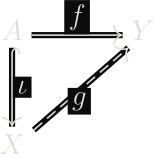
More generally, suppose we are looking for a morphism in a category that makes some diagram commute, but suspect that no such morphism exists. We may apply a functor into a category in which the problem is easier to study.
If existed in and made the original diagram commute, then would make its image commute in . In the triangle above, for example,
Therefore, if we can find a functor for which no morphism satisfies
then the desired cannot exist in (Notice that this implication only goes one way). The art is to choose a functor that re-frames enough structure to make the problem easier, while retaining enough information to expose the obstruction.
for example, take to be the disk, and take to both be its boundary circle with two points poked out (with the subspace topology). let just be the identity map. can we find some continuous such that ?
just apply . has two path components, while has only one, so squishes both components of into the one component of . if existed we would have
but the left hand side takes a two element set through a one element set, so it obviously cannot be the identity on two elements.
note: this section is more or less a direct adaptation of the IISC algebraic topology lectures, will put a source down below
4 - Computing the Fundamental Group of a Circle
Indeed, when one looks at the circle , which can be characterized as the unit circle in with the subspace topology, it seems like loops are homotopic to: staying at the basepoint, making round, rounds, or rounds (going clockwise instead of counterclockwise), and so on. This brings us to the lovely hypothesis:
where is the complex number . (Of course, the circle is connected, so base-point change gives isomorphic fundamental groups.) Now, homotopy theory comes with key ideas that help us prove such hunches, one of them being covering spaces.
Consider the continuous map given by . This map can be pictured as sitting atop the circle like a spiral staircase, where if you climb a floor, you’ve finished one trip around the circle.
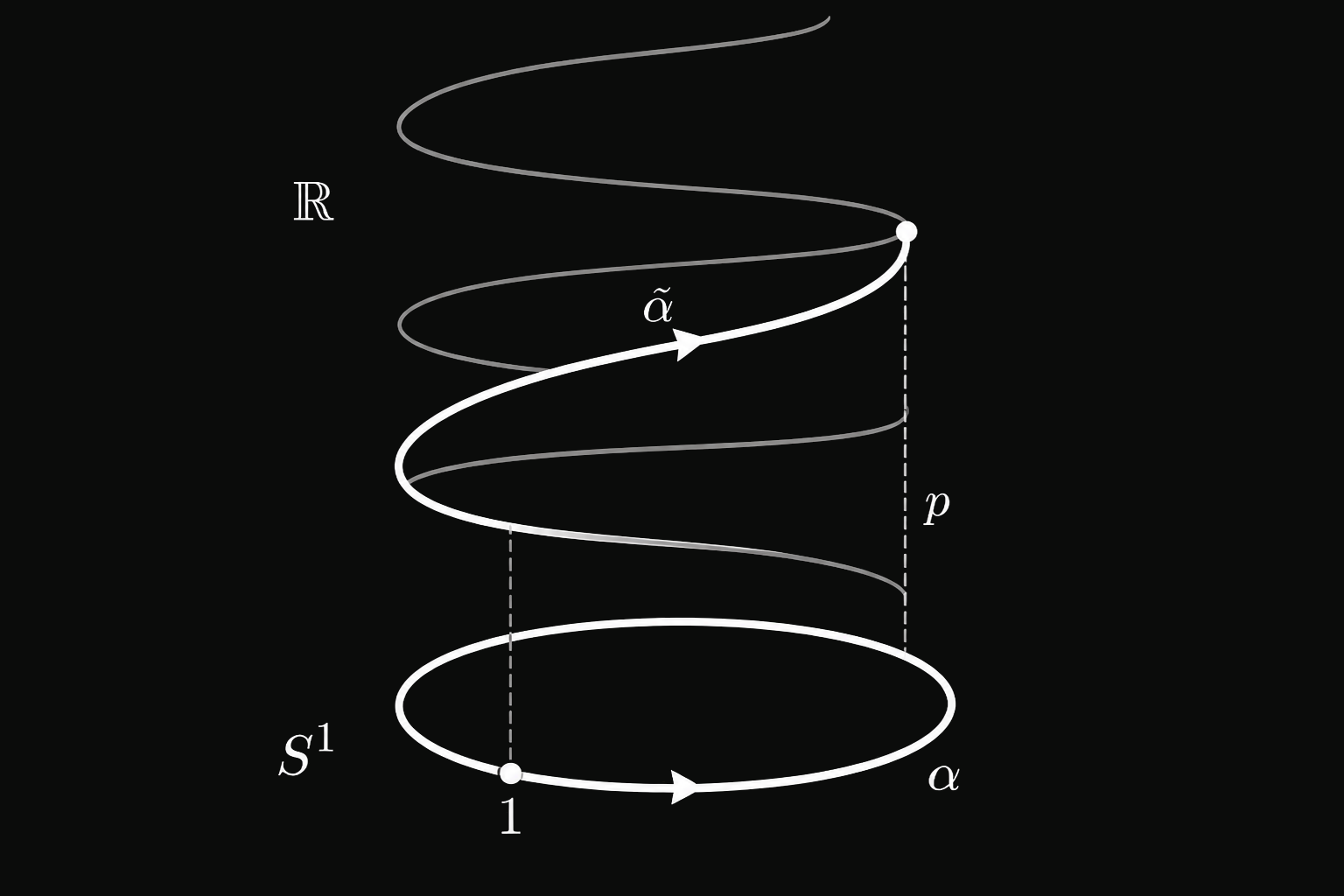
Now consider a loop . From the picture, it seems like any such loop, if you tell me which floor the preimage of the basepoint starts at, can be lifted into a path on the spiral, . What we shall do with this path is unclear, but it is giving us a simplification. (If you start the basepoint at floor on the spiral, and do two loops, you climb to floor two. Perhaps that helps?)
Another thing to notice is that this spiral, if you cut a small arc out of it, looks exactly like an arc of the circle. In fact, the disjoint arcs on each floor all have the same shadow, an arc of the circle, hinting at a particular kind of local homeomorphism. (As a question for the future, this feels like the topological analogue of as groups, we can explore that later.)
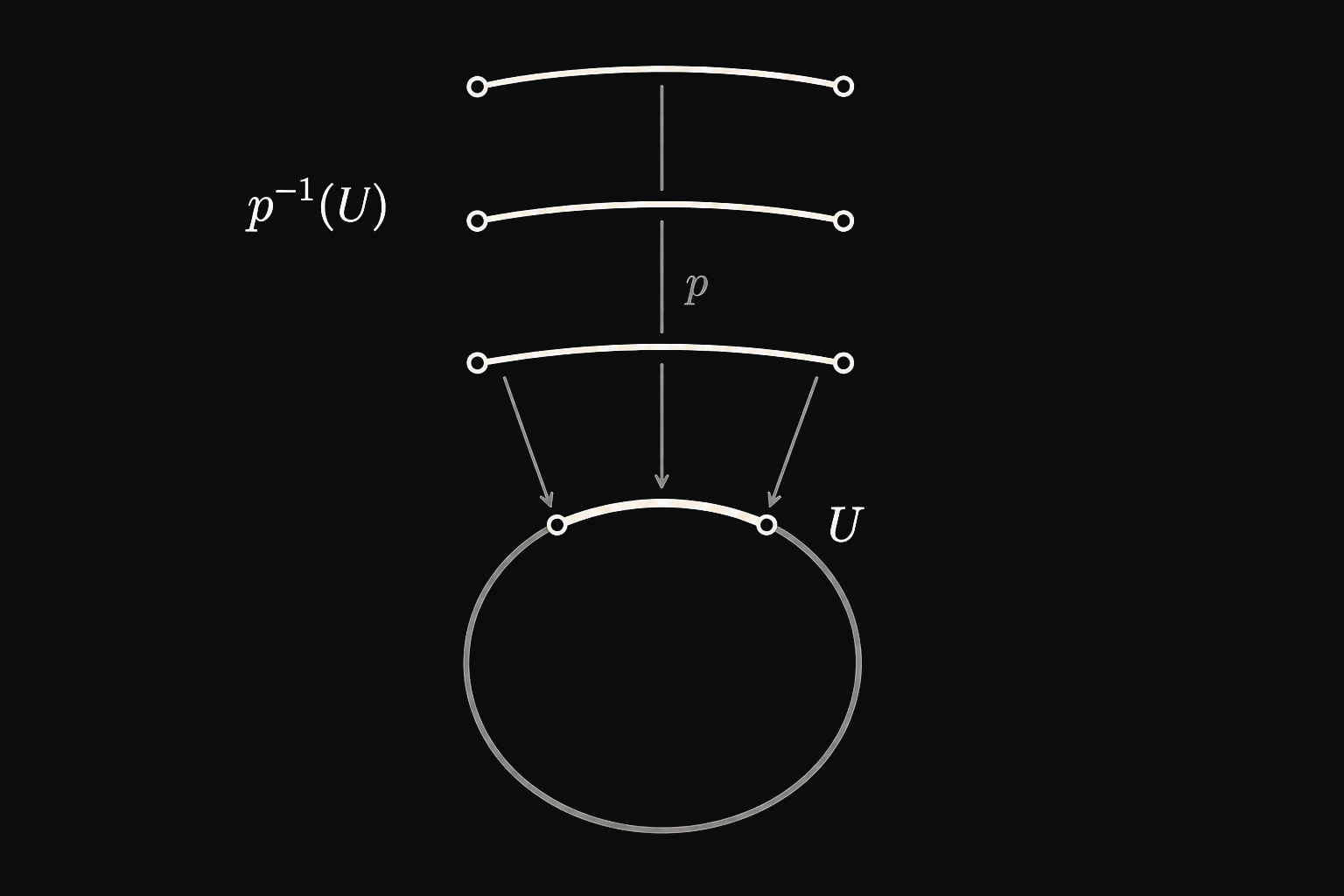
we define the following, let be a continous map: we say an open set is evenly covered if:
- is a disjoint union of open sets in , ie such that every is homeomorphic to via , that is is a map with continuous inverse (subspace topology on both sides)
Moreover, if is surjective and every point has some open neighborhood that is evenly covered, is called a covering map.
Now, we are to solve the following lifting problem in topological spaces, in this case a special one where is covering (note: we will show that the map from R to C is a covering map later)
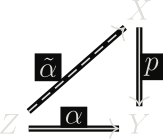
wouldn’t it be nice if we could somehow solve this covering problem locally, that is for each open set of ? we can solve a variant known as the relative lifting problem (basically stick an extension problem on top, (which is by the way dual to the lifting problem))
5 - Connectedness
Turns out there are many notions of contentedness, and we are using the weakest one below Definition (Connected). A topological space is connected if it cannot be written as with open, nonempty, and disjoint.
Definition (Path-connected). is path-connected if for any , there exists a continuous with , .
Definition (Simply connected). is simply connected if it is path-connected and for some (equivalently, any) .
Simply connected implies path-connected implies connected. Neither implication reverses.
6 - Local Relative Lifting
Let be a subspace of with some map :
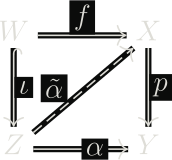
The above diagram is a general relative lifting problem.
Question: what construction recovers just the extension problem? or just the lifting problem?
Notice that the initial object of a category has a unique morphism to every other object.
Thus if is set to be the initial object, and the unique morphisms to respectively, Then the outer square automatically commutes are both the unique morphism from to . furthermore if is a solution to just the lifting problem (bottom triangle), then, noticing that are both the unique morphism from to , the extension problem (above triangle) is automatically solved.
Similarly, we can set the bottom triangle to be the final object and final morphisms to recover just the extension problem. Indeed, just like in sets, in topological spaces, the initial object is the empty set, and the final object is the singleton (upto isomorphism) both with the respective trivial topologies.
In a category with pullbacks any lifting problem can be turned into a relative lifting problem (there is in general no notion of subset and inclusion in a general category)
Okay, back to topological spaces
We will look at the “local” case of the above problem, which has the following constrains:
- is an evenly covered open set by .
- , that is, the space is chosen to be “small” enough to fit into this evenly covered open set.
- is a connected subspace of , equipped with some map to , for which the outer square commutes.
Our goal is to find .
First notice that for open sets . at this point you can imagine each disjoint fiber of over giving you a homeomorphism . Each of these are invert-able. and each inverse gives you a valid for which .
Suppose is not connected, and write for a separation of . We can define
Since and are disjoint open sets and each piece is continuous, is continuous. Thus, on different pieces of , a lift may take values in different sheets of .
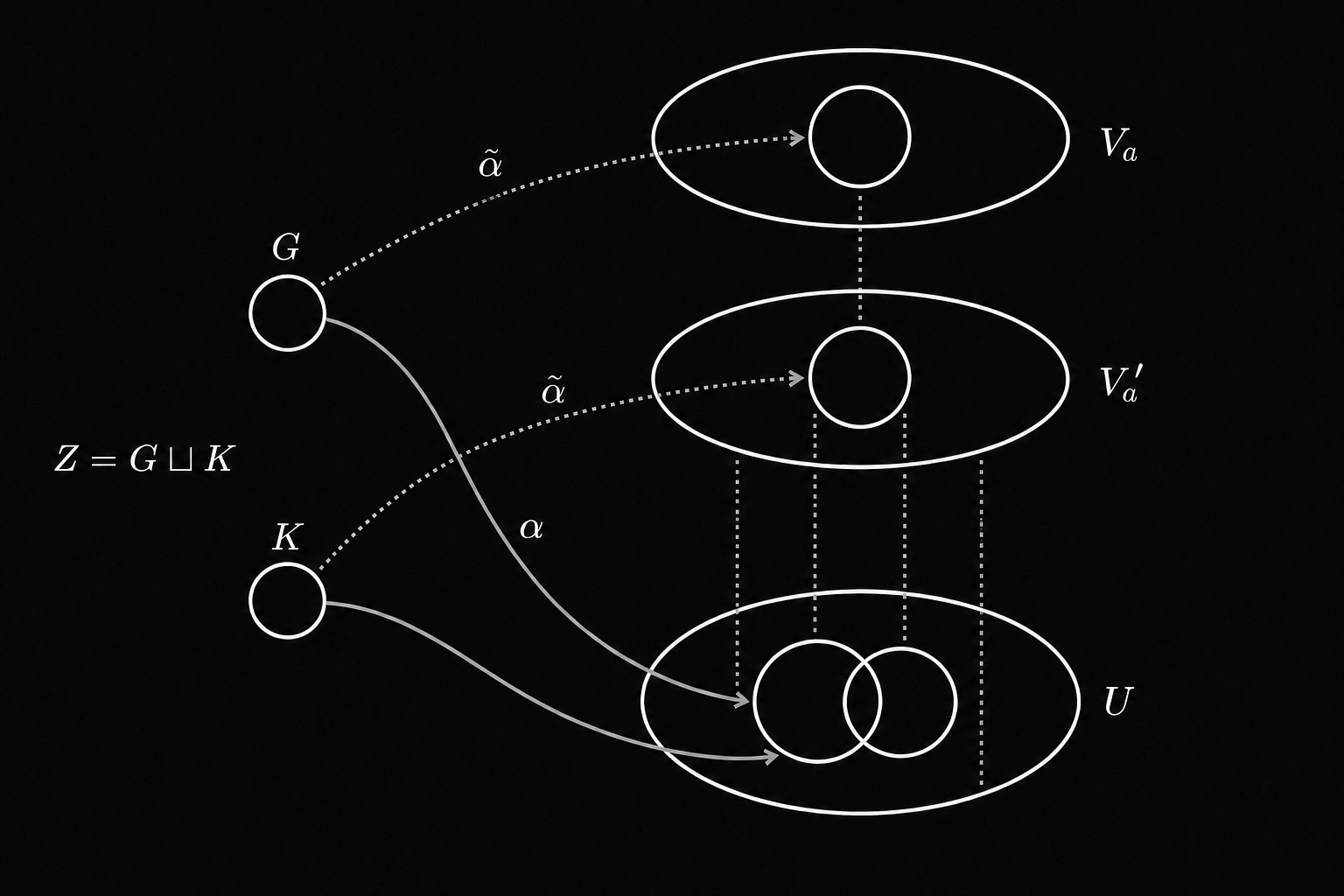
So far, we have not used the data given to us by the extension part of this problem at all, Indeed, is part of some connected part of . and is roughly telling you which sheet of to pick for the component that contains . This is because, . ie (as ) equivalently but of course since is connected, so is and thus for some sheet , .
We have already shown that countless solutions exist for
The extension part of the data picks out a sheet for the component in that is in. (In the above picture assume , and see the picture below)
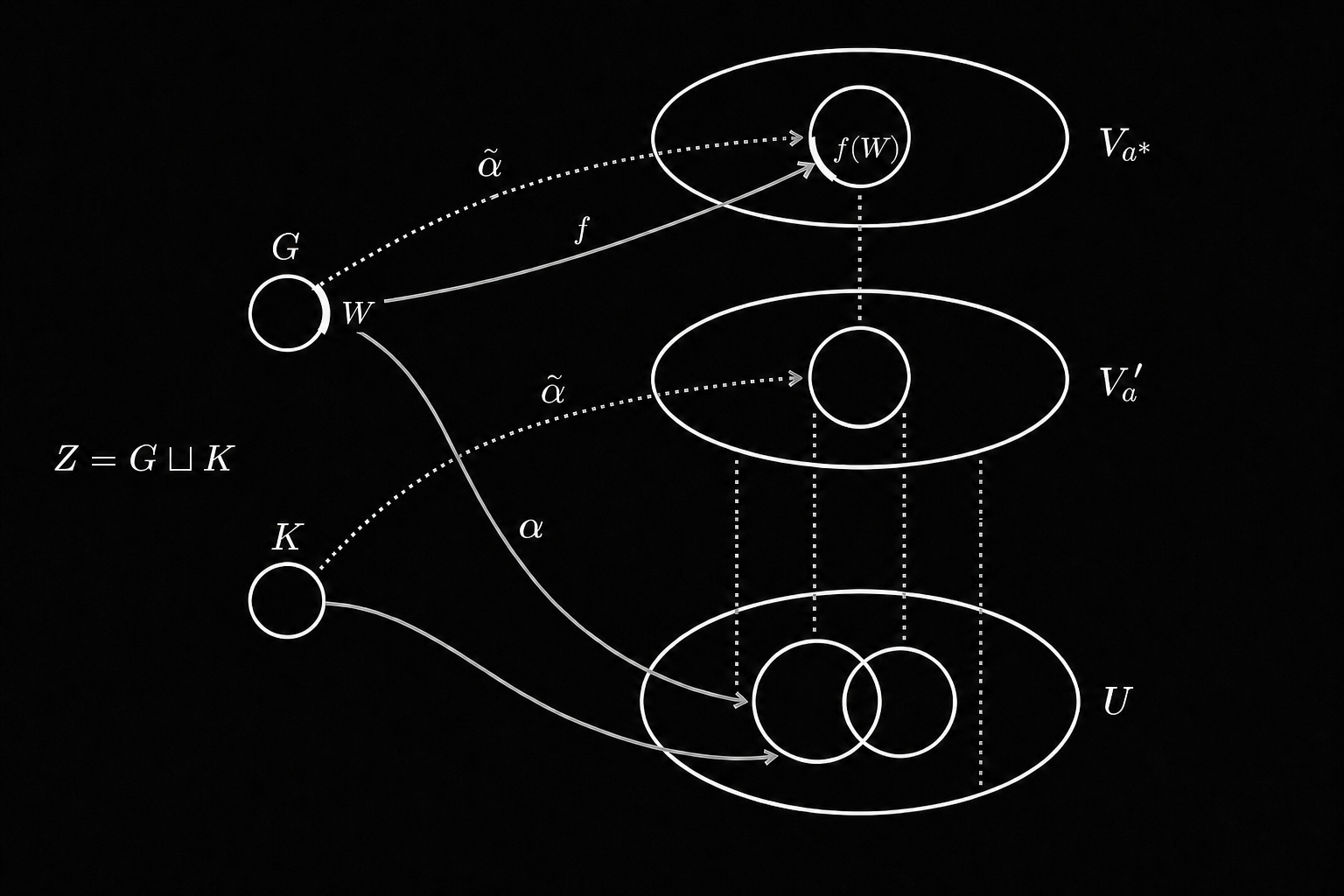 of course, finally, if is himself connected, (all of this assuming that is non empty ofc) it is very clear that is the unique solution to the whole relative lifting problem.
This is because whatever sheet is picked out by the entirity of under any must be in that sheet, ie therefore, thus is the unique solution.
Thus we can state the local lifting lemma cleanly for future use:
Local lifting lemma
Lemma. Let be continuous, let be evenly covered by , and let be a nonempty connected subspace with inclusion . Suppose and are continuous maps such that
Then there exists a continuous map satisfying
If is connected, then is unique.