Algebra - 2
Uploaded Last edited
In this entry, we will look at categories whose objects are certain diagrams in a category, and whose morphisms are identified with morphisms from the original category, such that some collection of diagrams commute.
0 - Categories from Commuting Diagrams
As an example, let be a category, and let be fixed morphisms from , , respectively.
We can make a new category whose objects are triples , where is an object of and are morphisms from to and to , respectively, such that the induced diagram commutes:
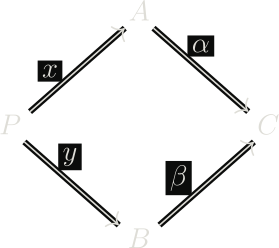
i.e. .
Now, what should morphisms in this category be?
Let .
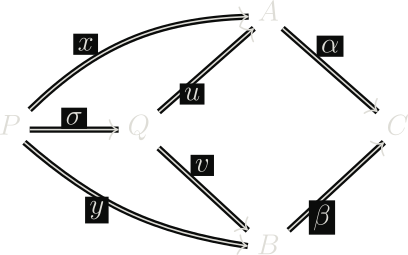
The most natural choice, of course, is to identify it with a morphism from to in the original category, such that the two triangles commute, i.e. , .
We claim that composition here is well-defined.
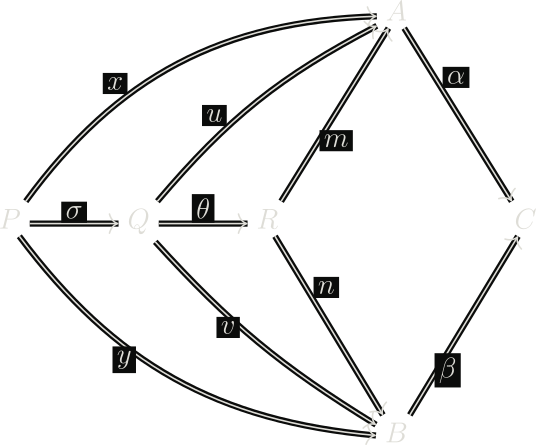
We want the morphism in that is the composite of the one identified with followed by the one identified with . Whatever this composite is, call it . If is identified by some morphism in the original category , it better be that and , but of course, is a good candidate for that!
That is, the composition of a morphism identified with and one identified with is the morphism identified with .
Now, what is the identity morphism on ? Well, it’s the one identified with in the original category, of course. (I will let the reader check that the identity axioms hold.)
Now, the above discussion, though it makes sense, feels a bit washy. If only we had ways to make categories out of diagrams in a rigorous way…
Enter functors:
1 - Functors and Natural Transformations
Functors
Let be categories. Then a functor from to is defined by:
- For each object in , an object in .
- For each morphism , a morphism (that is, a function from to , for any objects of ).
Such that the following axioms hold:
- For any object in , ; that is, the function from to induced by the functor takes the identity morphism to the identity morphism.
- For any two morphisms in , (note that on the left it’s, of course, the composition in the domain category, and on the right, the composition in the target category).
Natural Transformations
Now, imagine you had two functors , both from to . We want to find some transformation between these two functors. A transformation might want to encode the following:
For any object in , we have two images , , and there better be a morphism between them, . Indeed, is known as the ” component” of this transformation.
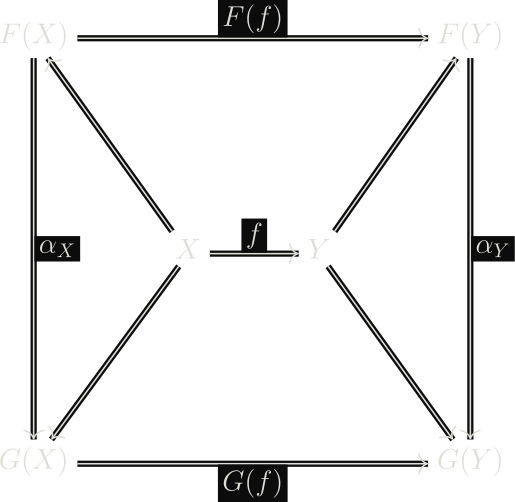
Now, any morphism in induces the above diagram, and if the outer square commutes—that is, for any morphism —we call a natural transformation from to .
Fix categories , , and consider the collection of all functors from to . We claim that these are the objects of a category, whose morphisms are natural transformations, usually denoted or .
Of course, taking the identity morphism on each object as the component defines the identity natural transformation on any functor : naturality is trivial here, since the square commutes for any .
For this to be a category, we also need a sensible notion of composing two natural transformations. Given and , wouldn’t it be very nice if simply composing their components, , gave us another natural transformation ? Indeed it does!
To see this, just imagine stacking a second square beneath the first: on top, ‘s naturality square for commutes (), and directly below it, ‘s naturality square commutes too (). Pasting the two squares together, the whole outer rectangle commutes:
which is exactly the naturality square for . So is itself a natural transformation , and this composition is associative and unital (by the identity transformations above) simply because composition in is. This makes a genuine category.
The general intuition behind naturality is this: a natural transformation gives you two routes from to for any , first apply then jump via , or first jump via then apply , and naturality demands these two routes always agree.
Endomorphisms and Automorphisms
An endomorphism of an object in a category is just a morphism , i.e. an element of . Since source and target agree, endomorphisms of can always be composed with each other, and is closed under composition, with acting as a two-sided identity. So is a monoid under composition.
An automorphism of is an endomorphism that is invertible, i.e. there exists with . Write for the collection of automorphisms of .
is a group. It’s a submonoid of consisting of the invertible elements:
- Closure: if , then has inverse , so .
- Identity: , being its own inverse.
- Associativity: inherited from composition in .
- Inverses: every has by definition, and is itself invertible (with inverse ), so it’s an automorphism too.
So is a group.
In general, a category in which all morphisms are isomorphisms is called a groupoid. In particular, a group is a groupoid with exactly one object :)
Subcategories
Let be a category. A subcategory of consists of a subcollection of objects of , together with, for each pair of objects in , a subcollection , such that:
- for every object in ,
- is closed under composition, that is, and implies .
These two conditions are exactly what’s needed for to be a category in its own right, with composition and identities inherited from .
is called a full subcategory if, for every pair of objects in , we have ; that is, doesn’t throw away any morphisms between the objects it keeps. It’s determined entirely by which objects you chose to keep.
There is a natural functor , sending each object and morphism of to itself in , called the inclusion functor. Functoriality is immediate: and , since composition in is just composition in restricted to .
2 - The Comma Category
Given two functors and , there exists a canonical category known as the comma category. In some sense, this construction is motivated by the following: when you have two functors from the same source to the same target, you get the functor category, whose morphisms are natural transformations. What happens when two functors instead fan into the same target, emerging from different sources?
Let us motivate it with a few examples.
Consider a category , and construct a new category out of it by fixing an object . The objects of the new category will be morphisms into . What’s a natural way to define morphisms in ? Well, we know objects are (identified with) pairs . Consider two such objects, and . Instinct tells us a morphism should be identified with such that .
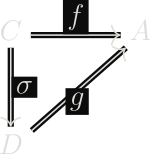
This is again of the flavor “objects are diagrams” and “morphisms fill the diagram in such a way that things commute.”
It is not hard to see that the above construction is a category, and thus I will leave justifying it out for brevity (composition of and is identified with the composite in , and one checks this again satisfies the required commuting-triangle condition).
Consider two such triples and .
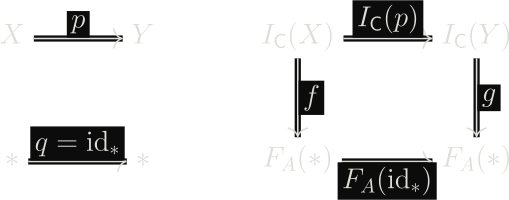
Since are objects of and is an object of , it makes sense that a morphism in would be identified with a pair , with in , such that the induced square commutes. (We smell a natural transformation here, and indeed we will encounter one.)
Of course, in the case at hand, this all simplifies: since has only the identity morphism, the pair collapses to just such that .
This inspires us to then define the comma category , for functors and .
Objects. Triples , where is an object of , is an object of , and is a morphism in .
Morphisms. A morphism from to is a pair , with a morphism in and a morphism in , such that the induced square commutes:
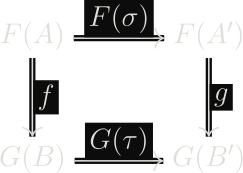
that is, .
Composition. Given and , their composite is , computed componentwise in and . One checks this is again a valid morphism , since pasting the two commuting squares together yields a commuting square with the composite maps. The identity on is the pair .
There are some cool things about the comma category (the promised natural transformation will also be uncovered),
but before that, there was this category we saw as the first example. The question is: how can this be constructed as a comma category?
3 - Diagram Categories
Let be a category, and let be a category describing a diagram, often known as an index category. We define a diagram of shape in to simply be a functor .
In particular, the whole idea of a diagram “commuting” in can be induced by placing that property on itself: if all paths of morphisms between any two objects of agree, then any functor automatically gives a commutative diagram in , by functoriality.
As an example, we may take to be the triangle category , with the only morphism from to being the mandatory composite of the other two.
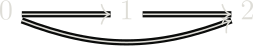
Any functor picking out objects and morphisms then forces , automatically, since in is the composite after , and functors respect composition.
For reasons now unknown to me, perhaps a mild (heavy) lack of sleep, I was holding onto the notion that the image under of each object in must be distinct in . Of course, this need not be true.
What I actually want here is subdiagrams. Given , a subdiagram of shape (a subcategory of ) is just the restriction . In particular, can be defined as the unique functor making the triangle below commute, that is, , where is the inclusion functor.
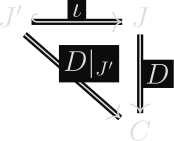
For instance, take to be the triangle , and , the sub-shape omitting the object and the morphisms touching it. Then just forgets and , keeping only , a diagram of the smaller shape in .
Now, it’s clear that the collection of all diagrams of shape in forms a category, namely the functor category , whose morphisms are natural transformations.
There are probably some cool ways to formalize “subdiagrams” within this category, but for now we are only interested in one particular kind of diagram: the constant diagrams, namely those that send every object of to the same object of , and every morphism of to the identity on that object.
For an object , we denote the constant diagram at by , that is, for every object , and for every morphism of .
Natural Transformations Between Diagrams
We are almost ready to reconstruct using comma categories, but it’s worth pausing to see what a natural transformation between two diagrams actually looks like, concretely, using the triangle shape from before.
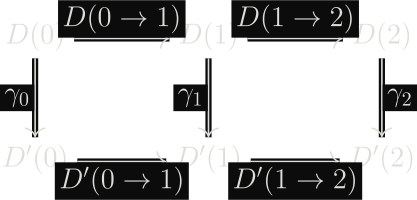
Let be two diagrams of this shape. A natural transformation consists of three components, , one for each object of , such that the whole diagram below commutes.
4 - Cones
Now imagine is the constant diagram at some object , and is a fixed diagram of shape , picking out objects and morphisms , (with , forced by functoriality).
A natural transformation then has components , , , one morphism out of for each object of the diagram.
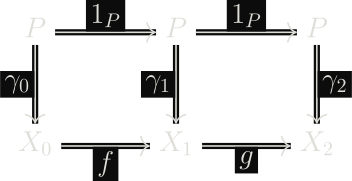
Naturality of the two squares reads and , i.e. simply
So the whole natural transformation collapses to a single choice: determines everything else, since are forced by composing forward along . This is exactly a cone over with apex .
Phew. It’s worth taking a step back and being a little pedantic here.
A cone over a diagram with apex is the pair , where is the constant diagram at , and is a natural transformation.
Hmm… now our balls (I do not intend to be sexist, I am just goofy) start to tingle again, as they have many times.
With wishful thinking and notational abuse, I could also write that cone as a triple , after all, is a morphism in the diagram category, and are objects of the diagram category. This is starting to look a little like the object of a comma category. But things are not sitting quite right, we still don’t have the canonical comma-category form.
For ease, call the category of diagrams over of shape , . To get , one thing we could do is send objects of to the constant diagram . We should carefully verify that this is indeed a functor.
It should send a morphism to the natural transformation whose components are all .
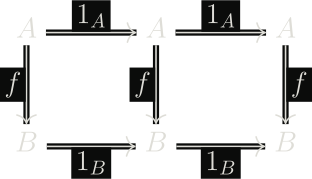
Indeed, this is well-defined as a natural transformation: each square commutes trivially, since .
Composition is well-defined, since the morphism we assign to is the natural transformation with every component , exactly the vertical composite of the transformation we assigned to followed by the one we assigned to . And identity morphisms on an object go to identity natural transformations on their constant diagram, since every component of ‘s image is itself.
This functor , , is exactly the diagonal functor .
So we’ve figured out a way to get ; now to figure out a way to get , a fixed diagram. Well, just make a functor that takes the lone object of the trivial category to the diagram .
With and both landing in , we are now sitting in comma category shape: the category of cones over is exactly . Objects are triples , that is, , matching precisely the pair we started with.
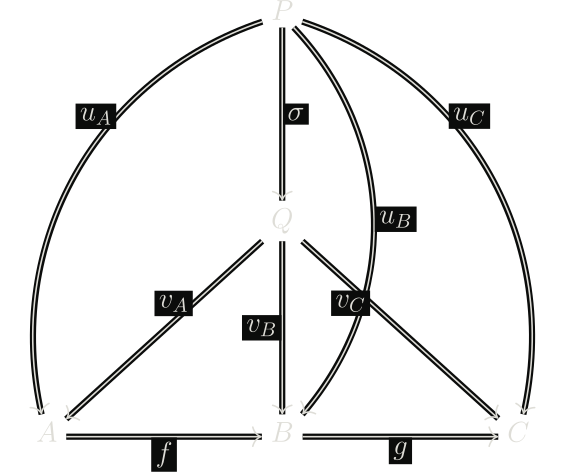
The picture associated with the category of cones is rather beautiful. If you have two cones with apexes and over the same diagram, a morphism between them is exactly what your gut expects: a morphism in the ambient category between the apexes, such that every triangle in sight commutes.
5 - What’s Next
In the next set of notes, we’ll verify that our comma category definition of cones behaves as claimed. We’ll also construct the promised natural transformation induced by the comma category, discuss universal properties, and return to our old goal of categorifying the first isomorphism theorem for groups, whatever that turns out to mean. (Wink wink: any universal property is a “terminal” object in some suitably engineered category.)
One of the reasons I keep stacking promises is simply due to the fact that I want to ship a writeup the same day that I do any math, owing to the fact that I’ve struggled with putting stuff out there before. In addition, I keep going down rabbit holes.
As to how this relates to the original text, I don’t know. I just wanted to build the categorical muscle.