wip
Uploaded Last edited
Graphs
A (simple) graph is a set, of verticies, and : two element subsets of , known as edges.
A sequence of vertices, with edges between subseqent verticies, is called a walk. If Each edge is unique (but a vertex may repeat) we call it a trail (there are some other names), if each vertex is unique, we call it a path. Finally, if we have a path, and take an edge from the last vertex to the first vertex, we have what is called a cycle.
let . we say is connected to , if there exists a path from to in . Indeed, the relation induced on is an equivalence, and partions into connected “subgraphs” (as defined below) such that any edge has both endpoints in exactly one connected component.
For two graphs we say is a subgraph of , if and .
A subgraph of can be induced by:
Selecting a subset of , and taking all edges in with both endpoints in . We call such subgraphs vertex induced.
Selecting a subset of , and taking the verticies of endpoints. We call such subgraphs edge induced.
We claim that if is connected, then has at least edges.
we will induct on , being the number of verticies, are obvious, suppose the hypothesis holds when
Take any connected graph on vertices, and remove , Then, let be the connected components of the resulting graph. let have vertices, by our hypothesis, has at least edges. Further, there must be at least 1 edge from into each connected component. Thus, the total number of edges is at least . Closing the induction
The handshaking lemma says, if you count the degree of each vertex, you count each edge twice, (once for each endpoint), thus
A coloring of the verticies of a graph, is a map where is the number of colors being used. we say a coloring is valid if whenever .
The chromatic number of a graph, written , is the smallest for which there exists a valid coloring with colors.
its easy to give an uppoer bound on based on the maximum degree of a vertex in , often denoted .
We claim , of course, any vertex is adjacent to atmost other vertices. Arrange the verticies of in any order say . We shall construct a coloring of inductively. set . Suppose you can color with at most colors. is only adjacent to at most vertices, even if all of them were colored distinctly so far, we have (at least) one extra color we can use to color .
Moreover, whenever is a subgraph of , we have . (simply inherit the coloring to ).
For a given graph , the number is the maximum number of edges you can put on an vertex graph, such that it does not contain as a subgraph, In problems of this flavor, is called the forbidden graph.
Suppose only is known. well, we know that for any , the complete partite graph, with nearly equal vertices in each part, has lots of edges, and can be colored with colors. But cannot be colored with fewer than colors, so This graph avoids as a subgraph.
But as we will show later, The complete partite graph, with nearly equal verticies in each part, is actually the best we can do, when is the complete graph on vertices.
Suppose is large, of all the candidates of with , is the densest candidate, in the sense that its got as little vertices and as many edges as possible. Just thinking of it in a back of the napkin way, avoiding means avoiding him in all sized subgraphs, of which there may be many, so you’d be removing a lot of edges.
Now,, suppose is connected, and , and . Now suppose . That means some in has an edge into , but otherwise, we would have . That is, is less dense than . We shall get into such ideas later, let us develop some machinery first.
Let be a graph, is known as an independent set, if the vertex induced subgraph by has no edges.
we can therefore say that is -colorable, if and only if there exists a partition of into at most independent sets.
This is obviously true, as any valid coloring has for each , to be an independent set. On the other hand, if one produces a partition of into sets where and each is an independent set, we may construct a valid coloring .
Let be an independent set. We say that is full if each has some for which is an edge. (Such a set is usually called a maximal independent set.)
On the other hand, suppose there exists for which there is no such that is an edge. Then, is an independent set with strictly more elements.
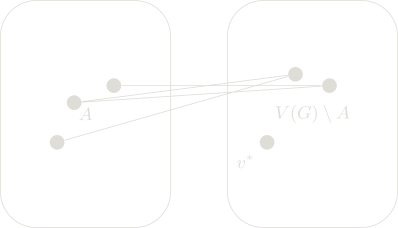
This means that if is an independent set of maximum size, then is full.
We claim that the converse is not true. For example, take the complete bipartite graph . The part with five vertices and the one with 10 vertices are both full, but only the part with 10 vertices has maximum size.
Now, we shall relate this to the chromatic number.
let be an independent set, then where is the subgraph induced by (you could color with just 1 new color).
Now we feel as though, if is a maximum independent set, then , and indeed, it is enough to show one coloring of with colors, where one color class is a maximum independent set.
We will give a counter-example: A graph where no optimal coloring has a maximum independent set:
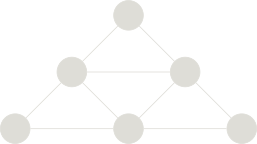
In the above graph, we see there is only one maximum independent set, namely (notice that any other 3-subset has at least one edge internally) but if are all colored the same, the internal triangle must use 3 new colors.
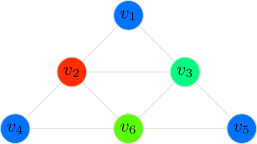
An optimal coloring is shown below. credit (https://math.stackexchange.com/questions/684077/graph-colouring-and-maximal-independent-set?__cf_chl_tk=fjeZiqSBC8CuG8sZaGfTGVZp84frS5LZdqvxnsZgwT0-1789336237-1.0.1.1-ls3XYRVWjPuJ6EE_9a1Glx8UKBd9tUtia3PJWpH6.uk)
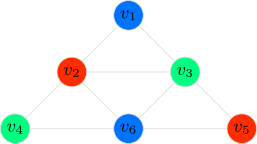
What is true, is that if , is a valid coloring, each color class has some with at least one edge into every other color class.
Suppose for the contrary, that any has some for which, has no edge into . In this case, we may color with the color . Doing this for each , we obtain a coloring of with at most colors, which is impossible.
We now take a small detour:
For each , There exists some such that if the complete -uniform hypergraph (meaning every hyper-edge is an s-element subset) on verticies is edge-colored with colors, There is a monochromatic complete -uniform hypergraph on verticies as a subgraph.
Notationally, we denote the complete uniform hypergraph on vertices as .
proof: Let be sufficently large, and color any -edge in one of colors, with uniform probability.
Now take some subgraph induced by a vertex set of size . Indeed, (upto isomorphism). Now, what is the probability of being monochromatic in edges?
There are edges, each of them must be the same color, ie the probability of being monochromatic in a particular color is . Thus,
Now, let for some sufficently large . We know that (due to inclusion-exclusion) The probability that some subgraph is monochromatic is at least the probability of one of many disjoint subgraphs, each isomorphic to being monochromatic.
That is, Let denote the probability that when is colored with colors, has a monochromatic copy of .
we have
Now suppose . Then it follows that , And thus, since every coloring of has a non zero probability, it must be that every coloring of contains a monochromatic copy of .
We shall re-visit traingle free graphs:
Let be a triangle free graph. And a vertex with maximum degree, Let .
Then, is an independent set, (where is all the vertices with an edge to ). Thus, every edge has at least one endpoint in .
Thus
Where the last inequality follows from , and thus, the sharp point tells us something about constructing the extremal triangle free graph. The AM-GM reaches equality when both numbers are equal.
That is, we know that the extermal graph has two roughly equal parts, and all edges are between these two parts.
Ie the extremal graph that is triangle free, is the complete bipartite graph with nearly equal parts.
Below, we have the most beautiful exercise. (1.1.3 in zhao’s book) Let be random vectors drawn independently from the same distribution on . prove that:
Graphs, Ramsey, Groups
A group is a groupoid of one object (indeed, a groupoid is a category where every morphism is an isomorphism).
this is mostly a quip
we say has finite order, if for some , . The smallest such we call the order of , usually denoted . If no such exists, we say that the order of is infinite.
The order of the whole group, is the cardinality of the underlying set, denoted .
suppose is finite, then for any for which , divides . since , we have , where
that is, . Obviously, it follows that , if , we contradict the minimality of , thus proving our claim.
The above claim is an equivalence, if is finite order, then for any , if and only if , for some integer .
It is important to note that cancellation holds in groups on both sides, ie and (the reverse directions obviously hold in both cases for any )
A group is abelian (or commutative) if for any we have . Usually, we use additive notation and write the identity element as where is commutative.
the notation giving operated with itself times, gets replaces by in an abelian group, of course may not be an element of in any sense. and if is negative, we mean operating the inverse of , times.
even if we may have , (it may very well be that is the identity or what not.
ex 1.3 , suppose is a group such that for each , , ie , when . We claim is abelian.
let , for any . we have , and thus and further . Proving our claim. The converse direction does not hold, for example is abelian, and there is no other than for which .
Now you may tell me, if is both finite and abelian, then we may get the property for each .
well, consider the group of , with addition of congruence classes modulo . From our earlier discussion, we know that this group is well defined inheriting the operator if any only if is a normal subgroup. It certainly is a subgroup, adding two multiples of gives you another multiple of , so it is closed after inheriting addition from .
is normal? well, we want to show that for any , which follows immediately as is abelian.
Okay, this was just me instilling enough structure. It is clear that is abelian, but if for example, .
So finite group order along with commutativity does not guarentee that elements have order atmost .
if is himself of finite order, we claim that every has finite order, and .
well, consider , These are products, thus they are not all distinct. ie there exists for which , but of course then , this must mean that is finite, and divides , which is a positive quantity, and of course .
We will eventually build to the theorem, that claims that if is of finite order, the order of each element divides the order of .
At this point, Allufi (my homie) says, the order of group elements don’t necessarily play nice with the operator, that is, you could have , both of finite order, but or “your favourite natural number” (his words not mine). And asks us to work out exercise 1.12
ex1.12, In the group of invertible matrices with real entries, let
we must verify that and .
We we treat them as linear maps, , (I ask the reader to to recall that matricies describe linear maps, and matrix multiplication is map composition)
ie is the composed linear map , therefore .
Now, notice under repeated application of (flip co-ordinate, negate the first one) we have:
Similarly for :
ie and
now, look at . it takes . If you were to apply again, you would see . Thus we inductively show that , which can never be the identity linear map, showing the desired result.
Moving in the line of “one cant really say too much about the order of products”, we will say little things.
let be an element of finite order. What can we say about the order of for some ? we know that it is finite.
the order of is the smallest number for which , that is is the smallest multiple of , such that the above equation holds. As seen earlier, is also a multiple of .
Conversely, any multiple of both and , call it , has the property that .
Thus, is the smallest such number, ie
that is:
Now, let be elements of finite order, such that they commute, ie .
let be a common multiple of . Notice, holds, as . Thus, .
ie the order of is finite, and in particular, we can choose . Thus, we have divides .
Naturally: ex 1.13 Give an example where commute, but is not equal to .
The multiplication table of a group, basically puts the operator relation into a table.
For a finite set , say , firstly we see that for elements of to be actually unique, we can’t have the same appearing twice on each row or each column.
Otherwise, we have and since groups have cancellation , or and hence .
so, it is clear that every element appears eactly once in each row and each column. Further, electing to be the identity, the appearance of is symmetric across the diagonal. (perhaps on the diagonal)
we claim that for there is only one multiplication table up to relabeling.
Well, electing to be the identity, the first row is , we may identify it with the identity permutation on .
Well, every other row, must be a distinct permutation on without fixed points. (the permutation on the first row has all fixed points)
counting permutations with no fixed points is sometimes called the hat-check problem.
let there be people. receives some hat that is not his own. Where, owns the hat .
now, there are two disjoint cases, either recives , in which case, we have the equivalent problem with people and hats, or recieves some other hat. There are hats remaining, (nobody else can recieve ). On top of that, can’t recieve . Remove and relabel to . Thus this is equivalent to the problem with people and hats.
ie where . Solving the reccurence gives us
so clearly this is not forcing in any way. But we will still leave the discussion in.
if , we have the trivial group, if , we have for which .
if , write . we have , thus and similarly, , which must mean that .
notice in this group, , but . Thus provoiding an example for ex1.3.
so all finite groups of order at most are uniquely determined up to isomorphism, and are abelian.
ex1.14 says, lets be elements of a group with finite order, are co-prime, and commute. we are to show that .
we know that divides , since , we have divides .
now suppose . then, therefore, . that is divides , but of course are co-prime, therefore divides .
Similarly, , so divides , and hence divides . Again, since are co-prime, divides . Select , thus showing .
ex1.8 Let be a finite group with exactly one element of order . Show that . (Allufi in my text misses that must be abelian, I was crying for a bit as to how one can define THE product independent of order, but all is well :))
Let where and .
Due to the cancellation law in groups, (or however you wish to argue) each has a unique inverse with no collisions, that is, if then .
Now we shall argue that if , . clearly , as this would make . Suppose . then , thus, , as has order 2. But of course,, again a contradiction.
thus but of course, due to abelianity, we can pair with in the product (this also implies is even btw) and thus we have the desired result.
The above exercise cleanly preceeds the next one
ex1.9, Let be a finite group of order , which exactly order-2 elements. Show that is odd, and thus deduce that if is even there must be some order-2 element in .
From the exercise above, we know that (excluding ) the other elements are either order or order at least . we further know that those with order at least have inverses of order at least , and that if is an order at-least 3 element .
That is to say, is partitioned (one partition may be empty) into , the two order elements, (whose inverse are themselves) and the remaining elements must be even, pairing up with inverses.
Ie for some . Thus, is odd. And it follows directly that if is even, is odd, and thus .
ex1.10: Suppose order of is odd, what can you say about ?
but of course, are co-prime. thus .
ex1.11 Show that for all ,
suppose , (for any ) then we would get .
Now we must show that .
Notice . That is, .
1.15 let be a commutative group, and be an element of maximal finite order. That is, if has finite order . Prove that if has finite order, divides .
The hint uses prime factorization. thus, we shall develop some number theory.
let for : Due to the well ordering principle (owing to the fact that is non empty, with either or in it, has a minimum element . by euclids lemma, where .
ie . ie since , this contradicts the minimality of , thus, it must be that . That is, . With a similar argument using , we have . thus put togeather, . But again, since is minimal, . In general, whenever is a multiple of we can construct solutions.
Moreover, the fact that along with induction can show that has integer solutions if and only if is a multiple of , and any multiple will do.
in particular, if and only if has a solution.
Chinese remainder theorem:
Now, let , where any two are co-prime. Select any integers . The system of equations has a solution, moreover, any two solutions are congruent modulo . We will prove the existance of a solution first.
We shall induct on . for , we know that since we have . Set
We have, obtaining , and similarly, .
Now, suppose the existance part of the theorem holds for some , let be solution of the first two equations, replace it with a single equation, . Clearly, any for is still co-prime with , as is pairwise co-prime with and . Thus, there is a solution to these equations. Thus colsoing the induction.
Now we shall show uniqueness upto modulo .
if are both solutions to the system, we have for each , since the ‘s are pairwise co-prime, this means that is, .
Another way to look at this is, take some classes
In particular, we are interested in , . This map is called Euler’s totient.
Notice, that is a prime, then . let be primes, and . Then, either or or . Of course then, we must remove the multiplies of : and the multiples of : . That is, . This of course assumes that .
Now, . next, we show that the totient is multiplicative, that is whenever are co-prime, .
let , , and .
we shall construct a bijection from to .
Measure
We will first develop some needed set theory:
First, recall that unions distribute over intersections and vice versa.
Now, let and .
We have the following:
Which follow easily from elementary set theory. Using induction we get:
Let for and .
If , then
where
note: the reason we are being anal about which universe are these sets in, is to ensure taking unions and intersections happen in the same land, and products are subsets of the products of the underlying universe, nevertheless we will mostly deal with , being the universe.
We call a set , where , an interval. (The notation is meant to unify half open, open and closed intervals.) The measure of an interval is defined to be . In particular, this means that the measure of a point, and the empty set, are both zero.
Let be a finite union of intervals, we claim that can be partitioned into disjoint intervals: write the endpoints of each in increasing order (ignoring repetitions). that is, we have
where each is one of the endpoints of some .
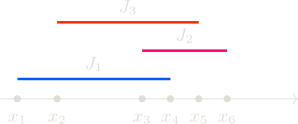
Thus, we make make disjoint intervals , , where each is either an open interval or the point as the interval .
Clearly, each is a union of some subcollection of . Thus, is a finite union of disjoint intervals.
we call the collection a refinement of .
we say is a box, if it a cartesian product of intervals. Suppose . Then we define the measure of , .
Let be a finite union of boxes. We claim that can be partitioned into finitely many disjoint boxes.
Let .
Now, for each , let be a refinement of .
That is, each is the disjoint union of some subcollection of .
Now for each , consider the product
If , then differs from in at least one coordinate, say . In that case and are disjoint. Thus, and are disjoint.
Finally, since each is a union of some of the , each is a union of some of the . Hence is a union of some of the , so these give the desired partition of .
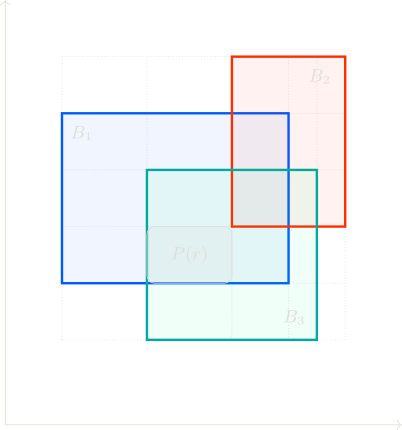
to get an intuition of the proof, look at the above picture, here the thick boxes are in the region between each vertical dashed line is a refinement of the -intervals, and between the horizonatal dashed lines, a refinement of the -intervals. thus every little box, is a product of refined intervals, clearly, not all such products are actually in one of , but we can pick those that are.
Awesome! this will come in handy (wink wink the measure of will be sum of the measures of each part in a partition of , and we will also show that two different partitions of will still have the same sum, though this is intuitively clear)
let be boxes, we claim that is a finite union of boxes. The proof follows from noticing that we can take the intersection co-ordinate wise, and the intersection of two intervals is a (possible empty) interval. The product with the emptyset is empty, which is a box.
Now, we claim that is a box. First, notice that . Let and
As we have seen above, , where when and when .
That is,taking co-ordinatewise intersection, after distribution the intersection over the unions
. But Thus,
but is a finite union of intervals. A consequence of the start of the notebook, is that we can allow the reader to convince themselves that this union can be distributed out.. OKAY FINE I’LL WRITE IT BUT JUST ONCE.
Let
write
Since, cartesian products are associative (upto isomorphism) we get (distributing the union over the product)
I WARNED YOU IT GETS UGLY. do it again, and we have
Indeed, is a box, thus is a finite union of boxes.
if is a finite union of boxes, we call an elementary set.
Let be elementary sets, where , . Of course, is an elementary set.
Notice
As shown earlier, the intersection of two boxes, is a box. Thus is elementary.
Now, we will unfortunately give a multi-line series of equalities.
But we have already establised that the difference of two boxes is a finite union of boxes, And is thus elementary. Moreover, we have established that the finite union and finite intersection of elementary sets are elementary. Thus is elementary.
Moreover, The symmetric difference is elementary, so is the translation (the translation of a box is a box)
Now, we shall measure an interval by counting (with normalization) the number of tighter and tighter grid points that land in it.
let . we claim that
where denotes the cardinality of finite sets, and
well, since is bounded, let be the smallest and largest integers (respectively) for which .
Thus, we have writing
we have ie,
Thus,
oh how nice would it be, if converges to and converges to , given that converges to , we can just do arithmetic on these limits! (they exist after all)
due to the minimality of and maximality , we have . Thus,
Rearranging we get:
Ie for any , whenever we have and .
Thus, proving the desired result.
let be a box, by definition, .
Thus,
since each limit exists, and is non negative, (not sure non negativity is needed btw) and the product is finite, we have
but of course, the product of cardinalities, is the cardinality of the cartestian product.
Thus,
Now, let be an elementary set, take any partition
Now, notice (again allowing interchanging a finite sum of limits that exist)
but of course, the sum of the cardinalities of a collection of disjoint sets, is the cardinality of their union
thus,
Notice that the right hand side is independent of the choice of partition of . Thus we define, the measure of an elementary set:
Indeed, the measure of an elementary set, is the sum of the measure of boxes that partition it.
Let , be a pairwise disjoint collection of elementary sets. It is clear (by choosing a partion of each into boxes) that
This property is called finite additivity.
Now, notice, if are elementary, we have and . But where all three sets are disjoint.
Thus, we have . This is called inclusion exclusion. It follows that
for any finite finite collection of elementary sets (not necerssaririly all disjoint)
Now, let , notice , a union of disjoint sets, thus, . This property is called monotonicity.
Now, notice that where is the translation of by . (This is easily shown by writing as a disjoint union of boxes, and noticing that the measure of each box is translationally invariant).
And of course .
Now, we have the weakest notion possible, of “measurable” sets, (and their measure) namely the elementary sets. we saw that the above measure had certain properties, we will say that any function assigning non neative real numbers to the elementary sets, with all the properties that has, is a measure of elementary sets. And we will study it.
let be the collection of elementary sets in and be a map. We say is a measure of elementary sets if:
. The measure of the empty set is under .
if are disjoint, (finite additivity).
if , (monotonicity)
for any , (translational invarience).
note: the property for not necesearilly disjoint , is called finite sub-additivity, and follows from 2. and 3.
We shall now prove certain things about any , that is a measure of elementary sets.
let be any point, seen as a box with all equal endpoints, we claim .
Suppose for the contrary that there is some for which . Then, due to translational invarience, for each , we have .
now, consider for each , points in . Due to finite additivity, and monotonicity (again treating each of these points as boxes with equal endpoints), we get , implying that is not defined.
Now, let , then we claim . (left as an exercise for the reader,due to its obvious nature)
Now, we pause, and ponder about the nature of certain arguments we’ve been making, a lot of it involves growing or shrinking of nice sets and taking limiting measures.
Let be a universal set, then we may form the subset category, whose objects are (any) subsets of and morphisms are (at most one between any two objects) if , or the superset category where a morphism means .
Both of these are poset categories, where the identity means , and composition depicts the transitive nature of inclusion.
Indeed, an infinite sequence of inclusions, , or dually ,
is a functor from (as an order category) to or respectively.
since we are considering All subsets of , the categorical co-limit of any such functor, exists and is equal to , the countable union, in and is equal to , the countable intersection in .
That is to say, That the countable union, and countable intersection, act as the least upper bound of the objects of such a functor, in their respective categories.
A clean way to look at it is: In , for any collection of objects, , its least upper bound and greatest lower bound exist (the greatest lower bound may be the empty set) and are given by and .
Form the order category of elementary sets in , among other things, a measure is a monotonic map to , it is thus a functor from .
Now let be a non decreasing sequence that is bounded above. we claim that . (An analog can be given for non increasing sequences that are bounded below)
Suppose is eventually constant, then obviously, that constant must be . That is, is eventually constant if and only if (the supermeum of a set in is either in it, or is a limit point of it).
But of course, if that is not the case is a limit point of . ie for each , there exists an infinite subsequence contained completely in the punctured ball .
Therefore, we have . but of course, since is non decreasing, for each , we have . thus, in either case our desired claim holds good.
Thus, let be a weakly monotonic sequence. That is, either is (eventually) non decreasing and bounded above, or non increasing and bounded below, then, converges to either or, respectively.
Indeed, whenever is a functor, between order categories, and is a collection of objects in for which the supremum exists in , and is a collection of objects in for which the spremum exists in ,
we have
This is true because transports the order into , thus is an upper bound of each . And so the least upper bound of the collection is at most any other upper bound.
Analogously, we have, whenever the infimum of the collections and ,
Approach from within:
Let be a collection of elementary sets, for which is also elementary.
We have the following inequality: (the left hand side because is a functor from the order on to , the right hand side follows from monotonicity of )
Now further suppose that is disjoint union with measure zero elements under . of course . Further suppose that whenever (for any) , there is some for which , then we have
approach from without:
let be a collection of elementary sets, for which Then we have
Now, suppose is disjoint union with some meausre zero elements, then of course further suppose that for any there exists some for which . Thus, we have
In particular, the above equalities hold when .
Now, we want to characterize the values that , a measure of elementary sets take. Due to translation invarience and finite additivity, it is sufficent to look at boxes whose corner is at the origin.
we write such boxes as where (that is each co-ordinate is non negative), of course is just notation for
Now, let . we want to know the measure, . Let , .
It is clear that upto disjoint union measure with zero elements,
Thus, due to finite additivity and the fact that the remaining elements are measure zero, as well as translational invarience, we have
since this is true for any measure of elementary sets, it is true for our good old elementary measure . but of course
thus, there is a fixed constant such that
now let such that each is the largest one at most .
notice, where
Thus of course, since is a box, by definition of , . But of course, the sequence is increasing, and bounded above.
Thus (monotone convergence theorem above) .
Now, we shall approach without. Notice
Where .
There is a very nice thing about , namely that his measure on boxes is the product of measure of the intervals, Thus, it is sufficent to show that for any ,
but of course, this is true, as and .
But of course again, due to monotone convergence, we have .
Now, notice since for each we have
Thus, we have
dividing by everywhere, we get . Thus,
That is, whenever is a measure of elementary sets, we have a constant such that for any elementary set .
in other words, the elementary measure determines all measures of elementary sets upto constant factor.
Indeed, the elementary measure plays nice with dimension in the following way, let , and be elementary sets. We claim that is elementary and that .
This is quite clearly true, let and , (each is a disjoint union of boxes)
Then, so is elementary
let and
clearly where when and when
Of course then,
rearranging we get
of course,
Thus, finally, we get .
This is pretty good, but you know, elementary sets can’t even be triangles or any other set that should be reasonably measurable.
Thus, we define the Jordan measures: Let be a bounded set.
we have the jordan outer measure
and the jordan inner measure
We say that is jordan measurable if its outer and inner measures agree.
We define and to be the outer and inner elementary sets of respectively.
Due to the nature of supremum and infimum in , (even for finite sets) we have, for any , there exists and such that and .
Exercise 1.1.5 (Characterisation of Jordan measurability). Let be bounded. Show that the following are equivalent:
is Jordan measurable.
For every , there exist elementary sets such that
For every , there exists an elementary set such that
follows directly: for each , we have elementary sets such that and and . Since is Jordan measurable, the outer and inner measures are equal, so .
. Let be elementary sets, . Clearly, and . Therefore,
But since this is true for any such , for each , there exists for which
Thus, , ie is Jordan measurable. note: will need boxes with shaded interor and so on
. let and let be elementary sets, for which . Notice . Thus, .
: let , and let be an elementary set for which . Again due to the nature of the infimum, there exists an elementary set such that . Ie, .
Now notice, since are elementary sets, is an elementary set, and we further claim .
let with . Since , we have and . Thus we have thus .
Now notice that is an elementary set, and (, hence ).
now notice since , we have
where .
Indeed, when is an elementary set, he is jordan measurable, and his jordan measure is equal to the elementary measure. thus we just use for both jordan measure and elementary measure.
Exercise 1.1.6. Let be Jordan measurable sets.
(Boolean closure) Show that , , , and are Jordan measurable.
(Non-negativity) Show that
(Finite additivity) If are disjoint, show that
(Monotonicity) If , show that
(Finite subadditivity) Show that
(Translation invariance) For any , show that is Jordan measurable and
We will take them one by one.
Let , and , (where are elementary sets) such that
(as shown above this is equivalent to saying E,F are jordan measurable)
Now note that .
Thus, due to the finite subadditivity of the elementary measure, we have , where . Thus is Jordan measurable.
Similarly, . That is, where . Thus is Jordan measurable.
For difference, we will take the largest bit out of (namely ) and the smallest bit out of namely .
Notice .
Also notice . thus,
. Therefore is Jordan measurable, and since difference and finite union of Jordan measurable sets are Jordan measurable, we have is Jordan measurable.
of course, the jordan measure of a jordan measuable set is non negative.
Now finite additivity, where are disjoint.
For ease, bring back the outer and inner elementary set notation.
First, notice
(indeed, there maybe some non elementary sets , where just magically happens to be elementary, so equality doesn’t need to hold) and
Now, if , in the reals, then supremum of is at most that of and infimum of is at least that of .
Thus, taking the supremum in the first inclusion,
On the other hand, taking the infimum in the second inclusion,
Thus
Monotonicity is quite obvious. Use inner elementary sets
Notice that , thus taking supremum on the measure on both sides, we get .
As with elementary sets, its straightforward to prove finite subadditivity from here (we will leave it as a quick exercise for the reader) So is translational invarience.
Now, we recall that if are metric spaces, then is continous, if for each and for each there exists some , such that, for each we have equivalently, since implies , the continuity condition can be written as .
The emphasis is that for a given output error and an input , the input error around for which is within is allowed to depend on both the input and the desired output error .
Now, suppose is a compact metric space.
let . Now for each , let be the real number for which .
of course the collection is an open cover of . Since is compact, using the lebegue number theorem (see algebra-5), we can manufacture with respect to this cover such that whenever and we have for some , . now for each , consider the ball . Clearly the diameter of this ball is smaller than . Ie there exists some for which . Thus,
Thus, notice by triangle inquality, that for any we have (since both of these points are in the ball around some ).
Ie, .
That is to say, for each , there exists a global such that for each , .
Such continuity is called uniform continuity. Further, if needed is linear in , ie there exists a global for which we call the function Lipschitz continous.
The above discussion gives us the theorem: let be a continous map between metric spaces, where is compact, then is uniformly continous.
I apologize for using B to denote both balls and boxes, hopefully the context above makes it clear.
firstly, as seen in (analysis-0) we may replace open balls with open boxes freely in arguments of continuity when we are dealing with . Before we proceed, we make a lemma, since in general it becomes extremely unwieldy to give a covering of boxes by evenly sized ones, but we will need it over and over.
For any point and any , we define the right open box of size around as
and the open box of size around as
Box-cover lemma
Let . For each , there exists a finite grid such that
covers by pairwise disjoint boxes. Moreover,
and
proof: let where clearly, , as . Note
On the other hand, is covered (disjointly) by
Thus, we have . where whenever .
Thus, define , due to finite additivity, and traslational invarience of the elemntary measure, we have
Thus, we get the desired result.
This discussion helps with the following exercise:
Let be a closed box in , and be continous. Show that the graph is Jordan measurable with Jordan measure .
Terry Tao gives us a hint, since (by Heinie Borel) is compact, is uniformly continous, and thus we perhaps need to use this fact.
We will first give an upperbound of the outer measure of .
let . Then there exists such that for each , we have .
Now, choose (where , thus we can safely say: by the box cover lemma, there exists a grid such that covers .
Hence covers the graph .
Now notice that since , we have .
Thus,
covers Now notice that is elementary in Thus, due to finite subadditivity and the property that
we have
thus we have using the upper bound in the box covering lemma
Thus, given that covers , for each we have
. That is, since the upper bound can be made arbitrarily small, we have .
Since the inner measure is non negative, we have . Thus, .
Area under the graph: In the same setting, show that is Jordan measurable.
As before, let , we have some for which .
Again, choosing where , we can use the box cover lemma to get the finite grid for which
covers . let .
and define
now, implies thus . Therefore clearly, covers .
further notice that
And hence,
Therefore, noticing that the right hand side is elementary, and applying finite additivity we get
first, we notice that as . Then we notice that since each are disjoint and cover .
Thus we obtain .
Indeed, since the choice of was arbitrary, for any , by choosing we have an elementary set for which . Thus by the characterization of Jordan measure (3), we have is Jordan measurable.
note all these arugments must be cleaned up
Exercise 1.1.8. Let be three points in .
(1) Show that the solid triangle with vertices is Jordan measurable.
(2) Show that the Jordan measure of the solid triangle is equal to
where
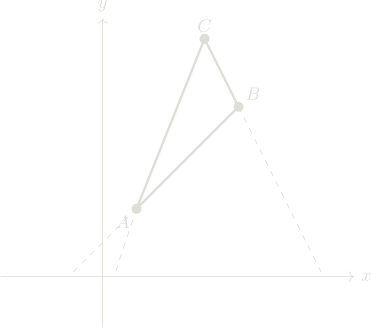
well, extending the triangles to meet the -axis gives us a nice proof strategy.
we must also in general be careful about triangles that are obtuse, even if their bottom side lies on the axis, it is not the case that there is a function describing them.
we will show that the right angled triangle with base on the x-axis is jordan measurable, with the intended jordan measure.
first, due to translational invarience, we may consider the following right triangle, where ,
Indeed, this is given by .
firstly it is clear that this function is continous, and by the above result, is jordan measurable.
Now, let be an elementary set that covers Then, is a disjoint union of boxes:
where (taking intersection with if needed) .
it is further clear that for each ,
ie applying AM-GM we get
Since this is true for any outer elementary approximation of we have .
Now Let
. Clearly covers
notice
ie
Thus the claim holds, similarly, we can prove that if then .
so we have the jordan measure of right triangles.
Now consider an arbitrary triangle whose base is on the -axis.
ie
and wlog suppose .
we have case1: In this case, we partition the set into two right triangles, taking co-ordinate
Due to finite additivity of disjoint sets (the line in between has measure zero) we have that firstly, since and are jurdan measurable, so is their union, and thus due to finite additivity, and translation we have
case2: yet again, with straightforward geometry,
we have as sets, and indeed, due to finite additivity and so on, the Jordan measure acts on when .
thus
now for an arbitrary triangle translate the lowest vertex to the origin
say
Moreover, without loss of generality, we may assume is the highest point.
Extend the line to meet the -axis at . Thus
notice
thus we have
and
thus we have
(the absolute value is just there to relax all the symmettry assumptions we’ve made)
Notice if is not at the origin, say
Jesus fucking christ we will now do the whole linear map thingy
exercise 1.1.9 show that every compact convex polytope is in is Jordan measurable.
Indeed, a closed convex polytope is the intersection of finitely many half-spaces of the form where , and its the usual dot product.
That is, a half space is basically the region under the plane given by .
A closed convex polytope is compact if it is also bounded.
Initially, I was crying for a very long time. trying to understand something deep about the geometry of such polytopes. Though that is very beautiful, we will reserve it for another day.
let be a compact convex polytope, Where .
since is bounded, there exists a closed box for which
Now notice that .
Thus, it is enough to show that the region given by a half space within a box is Jordan measurable, upon which we may invoke the fact that the finite intersection of Jordan measurable sets are Jordan measurable.
Ie, we need to show, for any closed box and any half space , that is Jordan measurable. Since we have translational invarience, it is enough to show it for boxes whose corner is at the origin, upon which we can translate it around.
Just to be clear, we are not just translating the box around, we are translating the whole region the box intersected with the half-space, so this is okay.
Ie for each and each half plane we need to show that is jordan measurable.
Indeed, we will show that there exists a continous map such that , and invoke the previous result, that the area under the graph of continous function on a compact space is Jordan measurable.
firstly, since not all , we may permute the co-ordinates (Ie the domain of will use a different set of d-1 axes) such that (we do this cause otherwise is not well defined. )
Thus, we have
where is an affine map which is continous, thus is a restriction of a continous map to a compact space, which is thus continous.
wow! what a beauty.
+# K6-Odd-Holes
The problem asks:
Let we say has a hole of size if there exists vertices such that the vertex induced subgraph (take the vertices and ALL POSSIBLE EDGES BETWEEN THEM) is EXACTLY equal to (the cycle on n-verticies)
Notice, if there even one crossing edge, then it is not a hole.
Does there exist a simple graph, which is free, And also free of Odd holes of size at least 5, for which any two coloring of edges has a monochromatic triangle?
Well, the first instinct is to hit the extremal graph.
on verticies, the Turan graph, with 5-parts (and nearly equal verticies) has maximal edges, and is free.
We claim that it is also free of odd holes of size at least 5.
well, let be an odd hole, of size at least 5 ie
Since a 2 partite graph is odd cycle free, we must have that any odd hole should occupy at least 3 parts.
if part is different (notice we have at least {v1,v2,v3,v4,v6}) then you have a chord (crossing edge)
Thus in general,
ie, all odd vertices must be in the same part as ie
are all in the same part but of course then the cycle can’t be completed. no edge from .
WOW! amazing, time to publish a paper I mean surely every coloring of this graph with many edges will have a monochrome triangle NOPE
NOT SO FAST MY FRIEND (this was a quip I saw in some book somewhere)
Indeed, there is a coloring, consider the 5 parts
color a “consecutive part” edge red. Ie, if where , then color him red.
color all other edges blue. A triangle chooses 3 parts. and a “THICCC” edge between them. suppose . wlog let .
there aren’t too many options here. our claim is at least one of j-i, k-j, k-i is equal to 1 and at least one of them is greater than 1. (mod 5)
p1 = vertex {P_{1}} @ 0,0 []
p2 = vertex {P_{2}} @ 4,0 []
p3 = vertex {P_{3}} @ 0,4 []
p4 = vertex {P_{4}} @ 4,4 []
p5 = vertex {P_{5}} @ 2,7 []
e1 = edge(p1,p2)  [teal,thick]
e2 = edge(p2,p3) [teal, thick]
e3 = edge (p3,p4) [teal, thick]
e4 = edge (p4,p5) [teal, thick]
e5 = edge (p5,p1) [teal, thick]
e6 = edge (p1,p3) [red, thick]
e7 = edge (p1,p4) [red, thick]
e8 = edge (p2,p4) [red, thick]
e9 = edge (p2,p5) [red, thick]
e10 = edge (p3,p5) [red, thick]
yeah so the extreme turan graph has A COLORING WITH NO MONOCHROMATIC TRIANGLE SADGE, well on the bright side this is a real problem now.
we will give special names to everything.
is free is straight forward.
is free of odd holes of size at least we will call tight holed.
is good if it is both free and tight holed. (WHY INNUENDO? WHY?)
if is of the nature that any 2-coloring has a monochromatic triangle, then we have is Triangular.
is GREAT if it is good and Triangular.
The question is do great graphs exist?
On Triangular graphs.
let be a graph, and we claim is not Triangular.
This is equivalent (beautifully) to saying that .
That is, make the THICC part graph, on , which parts.
there are only crossing edges, we will consider colorings where all crossing edges between the same two parts have the same color. so obviously the THICC part graph, in the worst case looks like and thus since for has a coloring with no monochromatic triangle, we are done.
That is to say, is triangular implies .
Now suppose . Does this imply that is triangular? if you give the thicc part graph, (same color for edges crossing a pair of parts) then obviously you can’t do it.
But again, not all colorings are THICC PART colorings. in fact (the complement) has but also not triangular.
p1  = vertex {P_{1}}  @ 0,5 [rose]
  p2  = vertex {P_{2}}  @ 2.70,4.21 [rose]
  p3  = vertex {P_{3}}  @ 4.55,2.08 [green]
  p4  = vertex {P_{4}}  @ 4.95,-0.71 [green]
  p5  = vertex {P_{5}}  @ 3.78,-3.27 [gold]
  p6  = vertex {P_{6}}  @ 1.41,-4.80 [gold]
  p7  = vertex {P_{7}}  @ -1.41,-4.80 [blue]
  p8  = vertex {P_{8}}  @ -3.78,-3.27 [blue]
  p9  = vertex {P_{9}}  @ -4.95,-0.71 [gray]
  p10 = vertex {P_{10}} @ -4.55,2.08 [gray]
  p11 = vertex {P_{11}} @ -2.70,4.21 [rose]

  // Cyclic distance 2: teal
  e1  = edge(p1,p3)   [teal,thick]
  e2  = edge(p2,p4)   [teal,thick]
  e3  = edge(p3,p5)   [teal,thick]
  e4  = edge(p4,p6)   [teal,thick]
  e5  = edge(p5,p7)   [teal,thick]
  e6  = edge(p6,p8)   [teal,thick]
  e7  = edge(p7,p9)   [teal,thick]
  e8  = edge(p8,p10)  [teal,thick]
  e9  = edge(p9,p11)  [teal,thick]
  e10 = edge(p10,p1)  [teal,thick]
  e11 = edge(p11,p2)  [teal,thick]

  // Cyclic distance 3: teal
  e12 = edge(p1,p4)   [teal,thick]
  e13 = edge(p2,p5)   [teal,thick]
  e14 = edge(p3,p6)   [teal,thick]
  e15 = edge(p4,p7)   [teal,thick]
  e16 = edge(p5,p8)   [teal,thick]
  e17 = edge(p6,p9)   [teal,thick]
  e18 = edge(p7,p10)  [teal,thick]
  e19 = edge(p8,p11)  [teal,thick]
  e20 = edge(p9,p1)   [teal,thick]
  e21 = edge(p10,p2)  [teal,thick]
  e22 = edge(p11,p3)  [teal,thick]

  // Cyclic distance 4: red
  e23 = edge(p1,p5)   [red,thick]
  e24 = edge(p2,p6)   [red,thick]
  e25 = edge(p3,p7)   [red,thick]
  e26 = edge(p4,p8)   [red,thick]
  e27 = edge(p5,p9)   [red,thick]
  e28 = edge(p6,p10)  [red,thick]
  e29 = edge(p7,p11)  [red,thick]
  e30 = edge(p8,p1)   [red,thick]
  e31 = edge(p9,p2)   [red,thick]
  e32 = edge(p10,p3)  [red,thick]
  e33 = edge(p11,p4)  [red,thick]

  // Cyclic distance 5: red
  e34 = edge(p1,p6)   [red,thick]
  e35 = edge(p2,p7)   [red,thick]
  e36 = edge(p3,p8)   [red,thick]
  e37 = edge(p4,p9)   [red,thick]
  e38 = edge(p5,p10)  [red,thick]
  e39 = edge(p6,p11)  [red,thick]
  e40 = edge(p7,p1)   [red,thick]
  e41 = edge(p8,p2)   [red,thick]
  e42 = edge(p9,p3)   [red,thick]
  e43 = edge(p10,p4)  [red,thick]
  e44 = edge(p11,p5)  [red,thick]
OMG THAT IS SO PRETTY! also doesn’t have a monochromatic triangle.
He is good (tight-holed and k6 free) but not triangular. And he has
A great graph, is thus necessarily, k6 free, tight holed, and is only colorable (vertex coloring).
But this is not sufficent.
we can run a computer program. (wow COMPUTER program)
We have another useful theorem.
definition, dual to the chromatic number, we have its clique number, which is the size of the largest clique contained in .
A graph is said to be perfect if, for every vertex-induced subgraph of , we have .
Strong perfect graph theorem:
is perfect if and only if it contains neither an odd hole, nor an odd anti-hole. (In this theorem all odd holes have size at least 5) IN GENERAL A HOLE IS DEFINED ONLY STARTING FROM SIZE 4, cause 3 is just a clique. some chordlessness of vertex induced subgraphs only makes sense from size 4 onwards.
where an anti-hole is is a complement of a hole. (In particular, contained an anti-hole means that the vertex induced subgraph is exactly the compliment of a cycle on those verticies)
Proof: (LEFT AS AN EXERCISE FOR FUTURE ME APPARANTLY ITS EXTREMELY NON TRIVIAL)
is GREAT implies
Suppose is GREAT. Then all of the following are necessary:
-
is -free. Equivalently,
-
is tight-holed: it contains no vertex-induced cycle for any .
-
is Triangular: every red-blue coloring of contains a monochromatic triangle. In standard notation,
-
is not -colorable. Indeed, if , take a proper vertex coloring of , color the edges between each pair of vertex-color classes according to a triangle-free red-blue coloring of , and obtain a red-blue coloring of without a monochromatic triangle. Therefore
-
Consequently,
so is not perfect.
-
By the Strong Perfect Graph Theorem, a non-perfect graph contains an odd hole or an odd antihole. Tight-holed excludes the odd-hole outcome. Hence contains an induced odd antihole.
-
The antihole cannot be because , which is an odd hole. It cannot have or more vertices because
so and every larger odd antihole contain a . Therefore every GREAT graph contains at least one of
as a vertex-induced subgraph.
This last conclusion is the important computational reduction: we do not have to begin from arbitrary graphs. Every possible answer grows around at least one of these three compulsory cores.
Conditions imposed on the computation
We search by increasing number of vertices. For each of the three cores
we generate graphs containing a distinguished induced copy of and add vertices around it. A candidate survives only if it passes every filter below.
1. Simple-graph conditions
The adjacency matrix must be symmetric, have zero diagonal, and have entries in . The distinguished vertices must induce exactly ; no edge of the core may be added or removed.
2. -free filter
Reject the candidate as soon as six vertices are pairwise adjacent.
When attaching a single new vertex to the core, an immediate necessary condition is that contain no : otherwise that together with forms a . This is only a quick local check; the full graph must still be checked for every possible .
3. Tight-holed filter
Reject the candidate if any odd-sized vertex set of size at least induces exactly a cycle. It is not enough merely to detect an odd cycle: the cycle is forbidden only when it has no chord among its chosen vertices.
During incremental generation, test immediately after attaching a new vertex . Later, also test odd holes involving several newly added vertices.
4. Chromatic filter
Reject the candidate if it admits a proper -coloring. We do not require exactly; values larger than remain legal. Computationally, the condition we need is simply
This filter is logically redundant once Triangularity has been proved, but it is a cheap and powerful rejection test before running the final edge-coloring check.
5. Triangularity as SAT
Give every edge a Boolean variable . Interpret as red and as blue.
For every triangle with edges , add the two clauses
and
The first clause forbids an all-blue triangle. The second forbids an all-red triangle.
- If the resulting SAT instance is satisfiable, the satisfying assignment is an explicit red-blue coloring with no monochromatic triangle. Reject : it is not Triangular.
- If the instance is unsatisfiable, every red-blue edge-coloring has a monochromatic triangle. Thus is Triangular. If it has already passed the and tight-hole filters, then is GREAT.
Equivalently, form the triangle hypergraph whose vertices are the edges of and whose hyperedges are the three-edge sets of the triangles of . Then is Triangular exactly when does not have Property B: its vertices cannot be -colored without a monochromatic hyperedge.
6. Remove duplicate work
Graphs that differ only by relabeling are the same candidate. Use canonical labeling to keep one representative of each isomorphism class. While extending a fixed antihole core, quotient attachment patterns by the dihedral symmetries of that core.
This reduction affects speed only, not mathematical correctness.
7. Keep certificates
For every rejection or success, save something independently checkable:
- a set of six vertices for a discovered ;
- the ordered vertices and induced edge set of a discovered odd hole;
- a proper -coloring;
- a red-blue edge-coloring witnessing that the graph is not Triangular;
- an UNSAT certificate when the Triangularity formula is unsatisfiable.
The first actual search is therefore:
Starting separately from , , and , add vertices through all legal attachment patterns, discard isomorphic duplicates, enforce -freeness and tight-holedness at every step, discard -colorable graphs, and ask SAT whether any surviving graph is Triangular.
A computational search extending just works?
  v0  = vertex {v_{0}}  @ 0,7 []
  v1  = vertex {v_{1}}  @ 3.78,5.89 []
  v2  = vertex {v_{2}}  @ 6.37,2.91 []
  v3  = vertex {v_{3}}  @ 6.93,-1.00 []
  v4  = vertex {v_{4}}  @ 5.29,-4.58 []
  v5  = vertex {v_{5}}  @ 1.97,-6.72 []
  v6  = vertex {v_{6}}  @ -1.97,-6.72 []
  v7  = vertex {v_{7}}  @ -5.29,-4.58 []
  v8  = vertex {v_{8}}  @ -6.93,-1.00 []
  v9  = vertex {v_{9}}  @ -6.37,2.91 []
  v10 = vertex {v_{10}} @ -3.78,5.89 []
  z   = vertex {z}      @ 0,0 [gold]

  // Cyclic distance 2
  e1  = edge(v0,v2)   [teal]
  e2  = edge(v1,v3)   [teal]
  e3  = edge(v2,v4)   [teal]
  e4  = edge(v3,v5)   [teal]
  e5  = edge(v4,v6)   [teal]
  e6  = edge(v5,v7)   [teal]
  e7  = edge(v6,v8)   [teal]
  e8  = edge(v7,v9)   [teal]
  e9  = edge(v8,v10)  [teal]
  e10 = edge(v9,v0)   [teal]
  e11 = edge(v10,v1)  [teal]

  // Cyclic distance 3
  e12 = edge(v0,v3)   [teal]
  e13 = edge(v1,v4)   [teal]
  e14 = edge(v2,v5)   [teal]
  e15 = edge(v3,v6)   [teal]
  e16 = edge(v4,v7)   [teal]
  e17 = edge(v5,v8)   [teal]
  e18 = edge(v6,v9)   [teal]
  e19 = edge(v7,v10)  [teal]
  e20 = edge(v8,v0)   [teal]
  e21 = edge(v9,v1)   [teal]
  e22 = edge(v10,v2)  [teal]

  // Cyclic distance 4
  e23 = edge(v0,v4)   [teal]
  e24 = edge(v1,v5)   [teal]
  e25 = edge(v2,v6)   [teal]
  e26 = edge(v3,v7)   [teal]
  e27 = edge(v4,v8)   [teal]
  e28 = edge(v5,v9)   [teal]
  e29 = edge(v6,v10)  [teal]
  e30 = edge(v7,v0)   [teal]
  e31 = edge(v8,v1)   [teal]
  e32 = edge(v9,v2)   [teal]
  e33 = edge(v10,v3)  [teal]

  // Cyclic distance 5
  e34 = edge(v0,v5)   [teal]
  e35 = edge(v1,v6)   [teal]
  e36 = edge(v2,v7)   [teal]
  e37 = edge(v3,v8)   [teal]
  e38 = edge(v4,v9)   [teal]
  e39 = edge(v5,v10)  [teal]
  e40 = edge(v6,v0)   [teal]
  e41 = edge(v7,v1)   [teal]
  e42 = edge(v8,v2)   [teal]
  e43 = edge(v9,v3)   [teal]
  e44 = edge(v10,v4)  [teal]

  // The four new edges
  e45 = edge(z,v0)    [red,thick]
  e46 = edge(z,v2)    [red,thick]
  e47 = edge(z,v5)    [red,thick]
  e48 = edge(z,v8)    [red,thick]
we shall characterize for (A cause anti-hole)
let be a clique in this means that the verticies of is an independent set in Conversely a largest independent set is a largest clique in
let be the verticies of . let be an independent set.
to each in , associate it with its suceeding vertex (indices are modulo ) since this map is injective. we have that is, .
now let
clearly is independent in (the neighbours of even index verticies are odd index verticies) and = .
That is, .
if , has no hole of length or greater.
suppose a vertex set , induces in , thus, induces in if , from the previous lemma, we have contains . but whenenver is triangle free. Thus a contradiction.
Therefore it must be that but the compliment of is . And clearly, when , no vertex induced subgraph of gives .
We will now shift our focus to . since , it is free. Further it has no odd holes. (it has no hole of length 5 or greater).
we will characterize triangle free colorings of . Notice, is regular, with the degree of each vertex equal to .
lemma: Any -coloring of the edges of without a monochromatic triangle, has, for each vertex , exactly red neighbours and blue neighbours.
(a red nieghbour of a vertex is a neighbour via a red edge)
Let the verticies of be labelled in cyclic order. Suppose for contradiction that some vertex has (at least) blue neighbours in a 2-coloring of the edges of without a monochromatic triangle. Due to symmetry we may suppose (otherwise re-label the vertices in cycling order starting at )
let be blue neighbours of
clearly, , as are not neighbours of
order them as it is clear that no matter how we choose ‘s, are non consecutive.
thus form a triangle, whose each edge is forced to be red. Which is a contradiction.
Therefore, every vertex has at most blue neighbours.
Similarly, every vertex has at most red neighbours.
Thus, every vertex of has exactly red and blue neighbours in a monochromatic triangle free coloring.
Indeed, contains induced by choosing any non consecutive verticies.
Any 2-coloring of the edges of that is triangle free has each color class (edge induced) equal to .
This follows from noticing that at most neighbours of a vertex in can be red, and at most can be blue.
Ie, each vertex in has exactly red and blue neighbours.
Ie each induced color class is -regular. There is only triangle free graph with verticies that is -regular, namely (this is true by seeing that each edge leaves a vertex, and reaches another, so starting from , you may hit , and one more edge is needed, which hits and so on,using the handshaking lemma, we have to put edges, so eventually, some edge hits forming a cycle, notice that this cycle cannot have length , and since we’re putting an odd number of edges, cannot have length , thus has to have length )
On with any cyclic labelling of verticies The cyclic distance The shorter route.
Inherit the same labelling on and thus define cyclic distance on it.
Our claim is that: If a 2-coloring of the edges of is such that
- is colored red
- The coloring has no monochromatic triangles.
Then, every edge of cyclic distance or is colored red. while every edge of cyclic distance , is colored blue.
Now let be an edge colored graph with edge coloring , and a vertex, for any subset of we define the color signature given by
Overlap lemma: let . That is, form and is a non edge such that is adjacent to all and so is .
Further let ‘s edges be two colored by such that there is no monochromatic triangle, and let then .
proof: Due to the previous lemma, and given that is and is (as vertex induced subgraphs)
Thus, they both have a red and a blue each. Deleting any one vertex, the leftover has a red and a blue .
since the coloring is shared, and share the exact same red and blue
for every the two unique endpoints needs to be joined by a vertex to get .
In particular, take the red , along with this forms a red , and along with also forms a red .
name the endpoints for the red and for the blue
we have have Similarly
Now, we notice that and are disjoint sets. (not sure if this needs further proof)
and thus, their union is .
Now, in define (indices are taken modulo 11, and to be the maximal clique induced by these verticies.
Notice induces a with indicies .
Moreover, since , are non adjacent in
Thus induces (as an isomrohism of course)
Therefore we apply the overlap lemma, assuming that the underlying 2-coloring of ‘s edges is free of monochromatic triangles. thus, for each
(again all indicies are modulo 11) and any ,
we have
Now, let be the cyclic group on the verticies of .
we may denote every edge in by uniquely the pair to mean the undirected edge (the cyclic group makes indexing concise, and ) is just a set, please note that is not a subgroup of cause that bitch has prime order.
the map can be inherited by the map on edges that the overlapping lemma preserves, along with the isomorphism (of sets) but of course is odd, on the other hand, is the same edge,
but notice in
thus we send to its canonical representative
Thus, is the composition of isomorphisms, .
Now, since is a permutation on the set , is a cyclic group. What is the order of this group?
well notice that .
In this representation has cyclic distance (we mean the endpoints of the vertices of the edge represented by (i,k) has that cyclic distance) let be the cyclic distance map. represents edges.
(I think it is better to leave out this esoteric and just directly work with edges, show that where indicies are modulo 11? idk)
we have if is even and if is odd. Moreover .
now let be a red edge. . The orbit of under are the edges we are to show that these guys are each unique edges, and cover 22 edges.
thus all these edges are red, and have cyclic distance 2 or 3. On the other hand there are only 22 red edges, so the remaining 22 blue edges have cyclic distance 4 or 5.
WE KNOW THAT is a subgroup of , on the other hand sends I mean this is doable.
Thus we have the biggest theorem, every traingle free 2 coloring of the edges of is (upto swapping of colors) the one that colors all edges with cyclic distance 2 or 3 red, and 4 or 5 blue.
Consider a cyclic labling of vertices,
Make a new graph , ,
First notice that induces as a subgraph of .
We claim that is free.
Well, is free.
Thus any must contain as a vertex, thus all verticies of this must be adjacent to , ie contradicting the fact that .
we claim that is odd hole free.
is free of holes of size or greater, thus, odd hole free. if has an odd hole, it must contain .
let be a hole induced by selecting and verticies in .
deleting leaves a vertex induced path on verticies in . we claim that and thus .
well suppose then we have as a vertex induced subgraph of .
notice ie that one is in thus, the endpoints are consecutive in thus is a non edge in .
so ie is odd hole free.
Now, for an arbitrary -coloring of the edges of , if the coloring on the subgraph has a monochromatic triangle we are done.
Otherwise has a special coloring.
In particular, is the same color, ie is monochromatic. (say red) On the other hand, are blue.
thus the induces by has red edges and blue edges.
Now the induced graph by taking is
If the inherited coloring is free of monochromatic triangles, it must have a red and a blue thus deleting should leave a red and blue , which is impossible.